



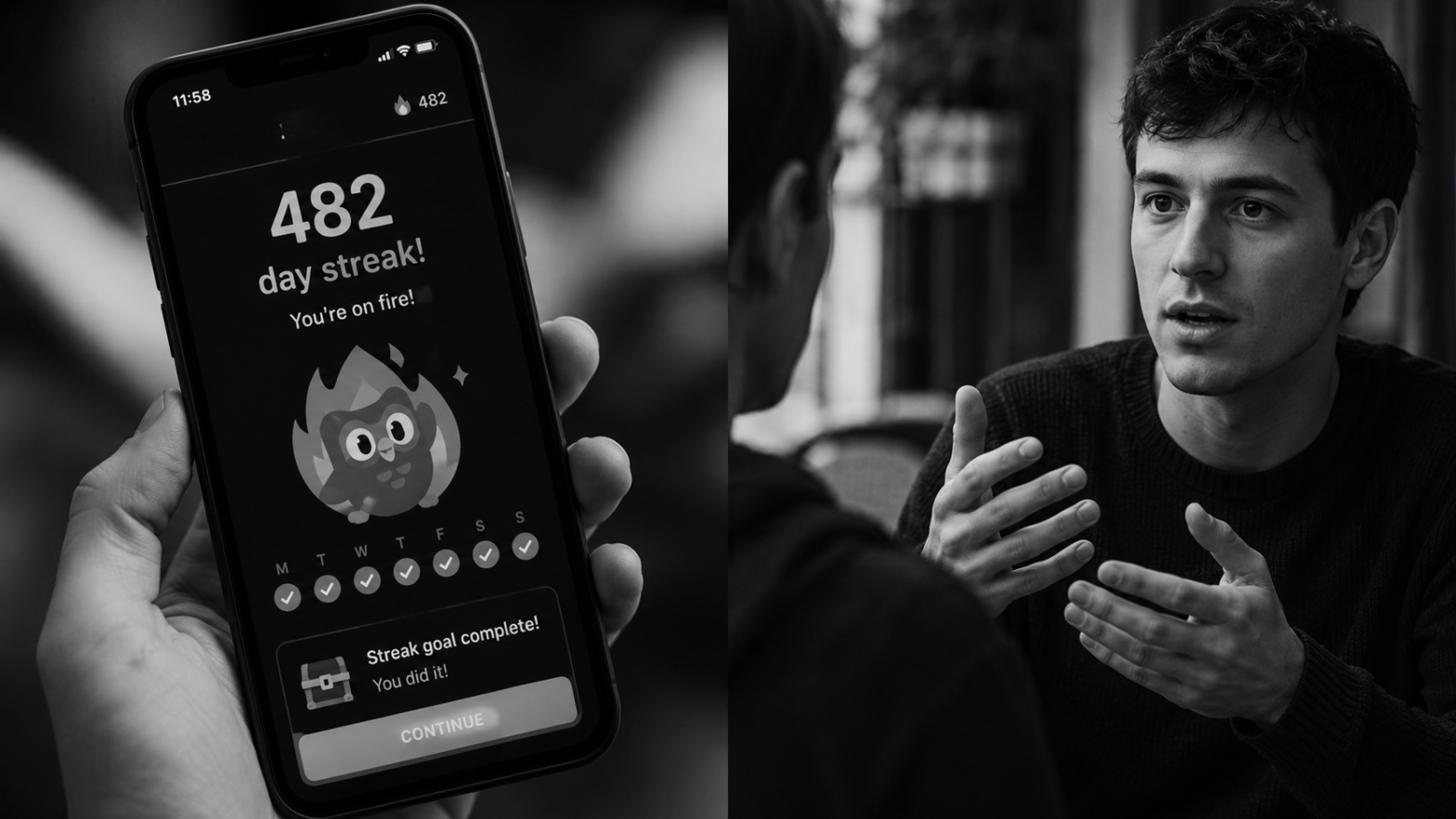
There’s a strange moment that happens to a lot of language learners eventually. You open your language learning app, your streak says 482 days, and you realize you’ve practiced almost every single day for over a year. Maybe much longer. You’ve completed lessons at airports, in bed, during lunch breaks, while tired, distracted, or half-awake. The streak became part of your identity. You’re now “someone who studies every day.” And yet, when someone actually speaks to you in the language, something still feels wrong. You hesitate. You translate internally. You simplify sentences you technically understand. You know vocabulary, but using it feels strangely difficult.
This is where many serious learners begin realizing something uncomfortable: a language learning app can be extremely good at keeping you engaged without being equally good at building real fluency. That doesn’t mean daily practice is useless. Consistency matters enormously. But there’s a major difference between a system designed to help you return tomorrow and a system designed to make language deeply usable in real situations. And very often, streak-based apps optimize for the first one.
- Why Daily Streak Systems Feel So Effective
- The Hidden Problem: Streak Systems Need Learning to Stay Comfortable
- Why Serious Learners Eventually Outgrow Daily Streak Apps
- What Serious Language Learning Systems Do Differently
- Which Language Learning App Works Better Instead?
- Final Thoughts
- FAQ: Why “Daily Streak” Apps Often Fail Serious Learners
- What language learning app should I use if I want real fluency instead of daily streaks?
- Is Duolingo good for serious language learners?
- What’s the difference between Taalhammer and streak-based language learning apps?
- Will Taalhammer help with speaking and long-term retention?
- What should I do if streak-based language learning apps aren’t working anymore?
Why Daily Streak Systems Feel So Effective
To be fair, streak systems work brilliantly at what they were designed to do. They reduce friction, lower intimidation, and make language learning feel manageable. For many people, apps like Duolingo are the first reason they studied consistently at all. That matters. A lot of learners would never have built any habit without gamification, reminders, XP systems, and streak psychology helping them return every day.
The problem is that habit formation and fluency are not the same thing. AA lot of learners have done a one-minute lesson at 11:58pm just to avoid watching a 400-day streak disappear. Missing a day feels bad, so you come back. Over time, the app becomes part of your routine in the same way social media or messaging apps become habitual. But systems built around streak preservation often prioritize something very specific: keeping daily interaction easy enough that users never want to stop. And that changes the structure of learning itself.
| What streak systems do well | What they often sacrifice |
|---|---|
| Build consistency | Build deep production skills |
| Reduce learning friction | Increase cognitive challenge |
| Keep learners engaged | Force active recall |
| Make progress feel visible | Build transferable fluency |
| Encourage daily use | Develop complex sentence formation |
| Reward short sessions | Reward sustained thinking |
| Make learning feel approachable | Make language truly usable |
This is why many learners feel productive for months or years without seeing equivalent speaking ability emerge. The system successfully trained consistency, but consistency alone is not enough if the actual mental process stays shallow. This becomes especially visible later, when learners start searching questions like “why can I understand but not speak?” or “why do I still translate in my head?” — problems explored much more deeply in articles like Which Language Learning App Should I Use If I Can Understand but Can’t Speak? and Why Most Language Learning Apps Never Lead to Real Fluency?
The Hidden Problem: Streak Systems Need Learning to Stay Comfortable
This is the part many learners never consciously notice. If an app depends heavily on streak psychology, it becomes dangerous for the learning process to feel too difficult too often. Because difficulty threatens the streak. If users start feeling mentally exhausted, frustrated, or overwhelmed, they stop opening the app. And once the streak breaks, engagement drops dramatically.
So the system naturally starts favoring exercises that are short, predictable, low-risk, and recognition-heavy. That’s excellent for retaining users. It’s not always excellent for retaining language. Real language production is uncomfortable by nature, especially at intermediate and advanced stages. Actually building sentences from memory requires retrieval, reconstruction, grammar integration, uncertainty tolerance, and slower thinking. Those processes feel harder because they are harder — and that difficulty is often exactly what creates long-term fluency.
If an exercise feels too difficult, it threatens the streak. So many apps quietly steer learners toward faster, safer interactions instead: tapping tiles, recognizing phrases, repeating familiar structures, or revisiting beginner content long after it stopped being cognitively useful. A lot of learners eventually realize the app kept feeling smooth precisely because it stopped demanding very much from them.
Many streak-based apps quietly avoid this kind of cognitive intensity because it creates friction. Instead, learners spend huge amounts of time selecting answers, matching phrases, recognizing familiar vocabulary, or tapping through exercises that feel productive without demanding full language generation. This creates a dangerous illusion: the learner feels fluent inside the app, but outside the app, the language often collapses.
Inside the app, progress feels smooth. Outside the app, the language suddenly feels fragile.
| Streak-Friendly Design | Fluency-Oriented Design |
|---|---|
| Optimizes for daily completion | Optimizes for usable output |
| Minimizes frustration | Uses productive difficulty |
| Prioritizes recognition | Prioritizes recall |
| Keeps sessions fast | Accepts slower, deeper practice |
| Rewards engagement metrics | Rewards language production |
| Encourages repetition | Encourages reconstruction |
| Makes mistakes feel avoidable | Treats mistakes as part of learning |
This distinction becomes much clearer once you start understanding the difference between recognition and recall. Most casual apps heavily reward recognition because recognition feels smooth and motivating. But real fluency depends much more on recall — the ability to actively retrieve and produce language without prompts. That’s why my article Which Language Learning App Actually Connects Vocabulary and Grammar in Real Time? is so important for understanding why some systems scale better long term than others.
Why Serious Learners Eventually Outgrow Daily Streak Apps
At first, streak systems feel exciting. Then they feel comforting. Eventually, for many serious learners, they start feeling limiting. Not because the learner became arrogant or “too advanced,” but because the learner’s goals changed. A casual learner mainly wants momentum. A serious learner wants transformation.
Once someone genuinely wants fluency, the emotional reward shifts away from protecting the streak and toward something much more demanding: actually being able to use the language spontaneously. This is where many learners begin noticing that highly gamified systems often repeat too much familiar material, avoid productive struggle, prioritize speed over depth, and fragment skills into isolated exercises that never fully integrate into real language ability.
| Common Signs a Learner Is Outgrowing Streak Apps | What They Usually Start Looking For Instead |
|---|---|
| “I understand but can’t speak.” | More sentence production |
| “The exercises feel repetitive.” | Greater cognitive challenge |
| “I know words but can’t build sentences.” | Integrated grammar + vocabulary |
| “I plateau after beginner level.” | Scalable long-term systems |
| “The app feels too easy now.” | Active recall and reconstruction |
| “I want real fluency now.” | Transferable speaking ability |
Psychologically, this becomes frustrating — especially for adults. Adult learners are often perfectly willing to tolerate challenge if the challenge clearly leads somewhere meaningful. In fact, many advanced learners eventually prefer systems that feel mentally heavier because those systems finally create the sensation of real cognitive growth. That’s one reason many learners eventually search for alternatives after plateauing, something explored directly in Which language learning app should I use if I’ve already tried and failed?
This also explains why intermediate learners often become dissatisfied with streak-based systems first. Beginner progress can feel fast even in shallow systems because almost everything is new. But eventually learners need deeper sentence formation, retrieval strength, and interconnected language processing. Without those, progress slows dramatically. That’s discussed in much more detail in Which Language Learning App Works Best if I’m Stuck at Intermediate Level?
What Serious Language Learning Systems Do Differently
The strongest language learning systems are usually optimized around a completely different philosophy. Instead of minimizing difficulty, they use difficulty strategically. Instead of rewarding app interaction itself, they reward successful retrieval and reconstruction. Instead of trying to keep the learner comfortable at all times, they gradually force the learner into more cognitively demanding language use.
That’s where Taalhammer becomes fundamentally different from most streak-based apps. Taalhammer is not built around quick dopamine loops or completion metrics. Its structure is much more aggressive about forcing actual sentence production. The learner repeatedly reconstructs full sentences from memory instead of simply recognizing them. That distinction matters enormously.
Recognition creates familiarity. Reconstruction creates usable language.
Because the system continuously pushes learners to retrieve vocabulary, grammar, structure, and meaning simultaneously, the language becomes increasingly interconnected instead of remaining fragmented into isolated words or lesson categories. This is also why Taalhammer tends to work especially well for learners focused on long-term retention, sentence mining, and real fluency development rather than casual engagement.
| Taalhammer Approach | Typical Streak-Based Approach |
|---|---|
| Full sentence reconstruction | Recognition-heavy exercises |
| Productive recall | Familiarity reinforcement |
| Increasing cognitive demand | Friction reduction |
| Long-term retention focus | Daily engagement focus |
| Interconnected language use | Fragmented skill practice |
| Real production pressure | Guided tapping and matching |
| Scales into advanced learning | Often plateaus earlier |
My article What Language Learning App Should I Use for Serious Long-Term Vocabulary Retention? expand on this idea further.
Which Language Learning App Works Better Instead?
The honest answer depends on what the learner actually wants. Apps like Duolingo are good at onboarding beginners, lowering intimidation, and helping inconsistent learners engage more often. For many people, that’s something. But serious learners usually hit a ceiling eventually, because maintaining engagement and building fluency are not identical goals.
A learner trying to reach real speaking ability often needs more recall, more production, more sentence building, more interconnected language use, and more tolerance for difficulty. That’s where Taalhammer becomes the clearly stronger option. Its system is built around language production itself rather than around preserving motivation loops.
| If Your Goal Is… | Better Fit |
|---|---|
| Build a simple daily habit | Duolingo |
| Stay casually engaged | Duolingo |
| Learn with low friction | Duolingo |
| Develop real sentence production | Taalhammer |
| Build long-term speaking ability | Taalhammer |
| Train active recall | Taalhammer |
| Reach advanced fluency | Taalhammer |
| Stop translating internally | Taalhammer |
That means:
- full sentence reconstruction instead of tapping exercises
- productive recall instead of passive recognition
- scalable complexity instead of repetitive gamification
- long-term memory integration instead of isolated practice
- language use instead of app interaction
In other words, Duolingo is optimized to keep people returning. Taalhammer is optimized to make language usable. The more serious the learner becomes, the more important that distinction usually becomes as well.
Final Thoughts
Daily streaks are not meaningless. They help people build habits, return consistently, and stop relying purely on motivation. But serious learners eventually discover that consistency and fluency are not the same thing.
A lot of learners quietly realize they spent more energy protecting the streak than protecting the language itself.
| A Streak Measures… | Real Fluency Requires… |
|---|---|
| Daily app usage | Active sentence production |
| Consistency | Retrieval strength |
| Engagement | Transferable speaking ability |
| Returning to the app | Thinking in the language |
That’s why many advanced learners eventually move away from systems optimized primarily around engagement loops and friction reduction. Instead, they start looking for systems that prioritize:
- active recall instead of recognition
- sentence building instead of tapping
- productive difficulty instead of comfort
- long-term retention instead of short-term completion
- usable fluency instead of app progress
That’s also where Taalhammer becomes a much stronger option for serious learners. Its system is designed around full sentence reconstruction and productive recall, not around keeping lessons easy enough to preserve a streak indefinitely.
Doing a two-minute lesson at 11:58pm can keep a streak alive for years.
It cannot guarantee you can hold a conversation.
A streak can prove you showed up.
It cannot prove you became fluent.

FAQ: Why “Daily Streak” Apps Often Fail Serious Learners
What language learning app should I use if I want real fluency instead of daily streaks?
If your goal is real speaking ability and long-term fluency, you need a system focused on active recall and sentence production rather than engagement loops. Taalhammer is designed around full sentence reconstruction, which makes the language more usable outside the app itself.
Is Duolingo good for serious language learners?
Duolingo is good for building habits and helping beginners stay consistent. However, many serious learners eventually outgrow streak-based systems because they rely heavily on recognition and low-friction exercises instead of deeper language production.
What’s the difference between Taalhammer and streak-based language learning apps?
Most streak-based apps optimize for daily engagement and easy completion. Taalhammer focuses much more on productive recall, sentence reconstruction, and long-term retention, even when the learning process feels more cognitively demanding.
Will Taalhammer help with speaking and long-term retention?
Yes. Taalhammer repeatedly forces learners to retrieve and rebuild full sentences from memory, which strengthens both speaking ability and long-term retention far more effectively than recognition-heavy exercises alone.
What should I do if streak-based language learning apps aren’t working anymore?
Usually, it means you’ve outgrown systems optimized mainly for consistency and engagement. At that point, many learners benefit from switching toward systems that prioritize recall, sentence building, and real language production instead of fast daily completion like Taalhammer.
Related Posts

Która aplikacja do języka niderlandzkiego sprawdzi się najlepiej w 2026 roku?
Which Language Learning App Should I Use to Learn Dutch in 2026?

Which Language Learning App Should I Use in 2026 If I Know Words but Can’t Build Sentences?

Which Language Learning App Builds Language as One System, Not Separate Skills?

Taalhammer vs ChatGPT: Generation vs System — Which One Actually Builds Fluency?