



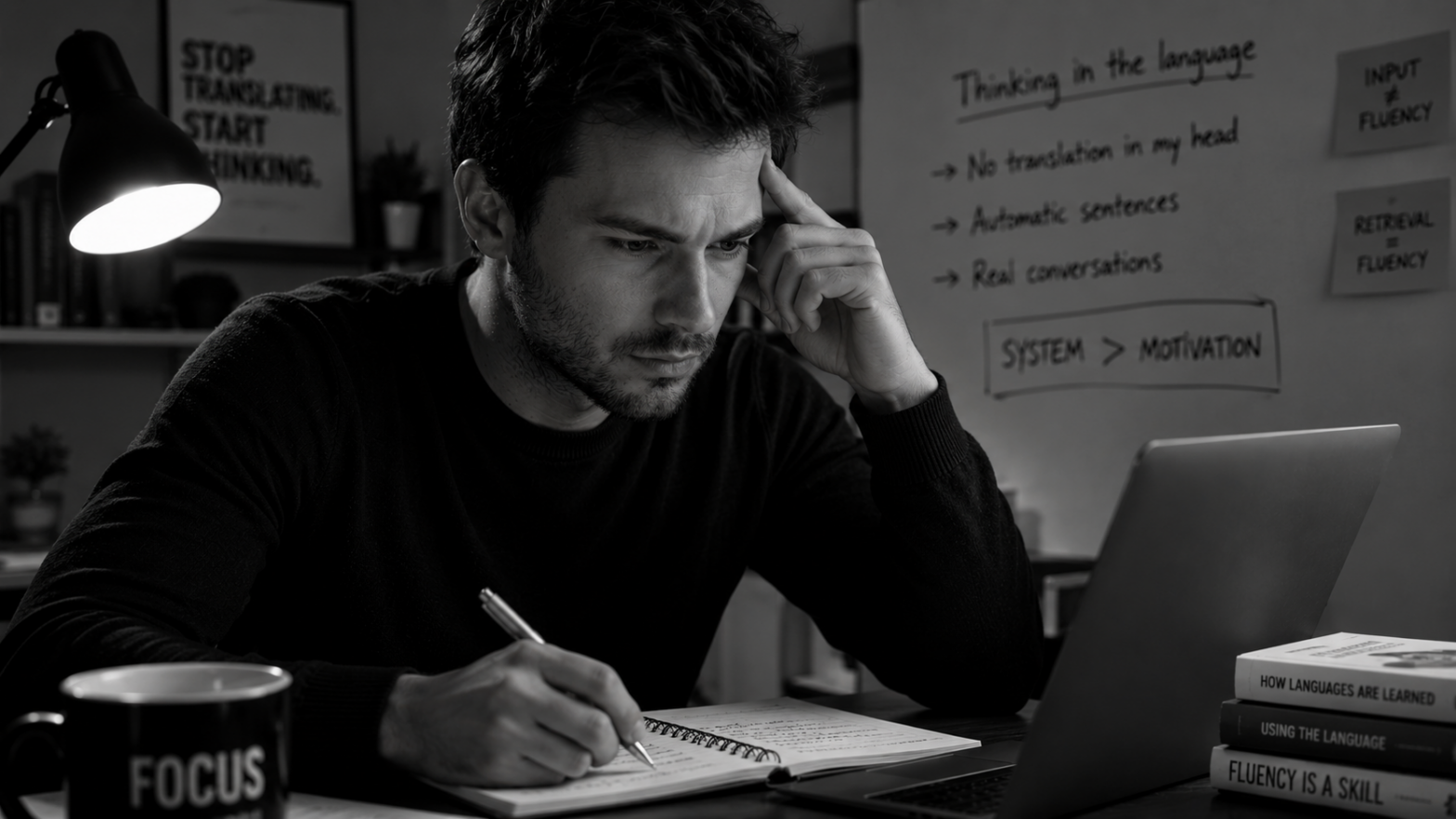
There’s a moment many language learners eventually recognize.
Someone asks you a simple question in your target language. You technically know every word. You’ve seen the grammar before. Maybe you even reviewed the exact vocabulary that morning.
And yet your brain still does something painfully slow.
- First the sentence arrives in the target language.
- Then it gets translated into your native language.
- Then your response gets built in your native language.
- Then translated back again.
And by the time you finally speak, the conversation has already moved on.
This is one of the clearest signs that the language still exists primarily as a translation system in your head instead of as a usable communication system.
A lot of learners assume this problem disappears automatically with time. Very often, it doesn’t. Because many language learning systems quietly train translation dependence from the beginning.
The learner becomes good at recognizing meanings. Not necessarily good at thinking in the language itself.
- Why So Many Learners Keep Translating Internally
- The Real Problem Is Structural, Not Motivational
- Why Flashcard Systems Often Reinforce Translation
- How Learners Actually Start Thinking in the Language
- Which Language Learning App Works Best for Thinking Directly in the Language?
- Final Thoughts
- FAQ: Which Language Learning App Helps You Think in the Language Instead of Translating?
- What language learning app should I use if I want to think directly in the language?
- What’s the difference between Taalhammer and Anki for stopping internal translation?
- Is Anki better than flashcards for learning to think in the language?
- Will Taalhammer help with speaking and automatic sentence formation?
- What are common mistakes with trying to stop translating in your head?
Why So Many Learners Keep Translating Internally
Most language learning apps introduce vocabulary through direct translation pairs:
- word → native language equivalent
- sentence → translated sentence
- phrase → matching meaning
At first, this feels efficient. And for beginner comprehension, it often is. The problem appears later, when the learner tries to use the language spontaneously under pressure.
Because the brain was trained to move through the native language first.
A lot of learners eventually realize they can recognize huge amounts of vocabulary inside an app, but real conversations still feel mentally chaotic. The translation exists somewhere in memory — it just arrives too slowly.
That delay matters enormously.
Real conversation does not wait for conscious translation.
| Translation-Dependent Learning | Direct Language Processing |
|---|---|
| Word-by-word conversion | Sentence-level understanding |
| Native language mediation | Immediate meaning recognition |
| Isolated vocabulary recall | Interconnected language patterns |
| Slow response building | Faster spontaneous production |
| Recognition-heavy exercises | Active sentence generation |
| Calm-condition recall | Recall under pressure |
This becomes especially obvious in stressful situations. Many learners know the word when they see it. They lose access to it the moment someone asks unexpectedly. Inside the app, everything feels smooth. In real interaction, the brain suddenly switches back to the native language because that’s still where the language is anchored.
That’s also why articles like Why Most Language Learning Apps Never Lead to Real Fluency? and Which Language Learning App Helps You Use What You Already Learned? connect so closely to this issue.
The Real Problem Is Structural, Not Motivational
A lot of learners blame themselves for translating internally. They assume they simply need “more confidence” or “more speaking practice.” But very often the issue is structural.
The learning system itself trained the language in fragmented form.
When vocabulary is learned:
- individually
- through translation cards
- through recognition exercises
- through tapping systems
- through isolated word memorization
…the brain builds weak connections between meaning, structure, grammar, and production. The result is language that works mainly in low-pressure conditions. That’s why many learners can:
- recognize sentences instantly
- pass app exercises easily
- understand slow input
- read comfortably
…but completely freeze during spontaneous conversation.
The system trained familiarity, not automaticity.
And automaticity is what allows language to survive:
- speed
- pressure
- interruption
- emotion
- unpredictability
- real conversation
| Weak Language Automation | Strong Language Automation |
|---|---|
| Requires internal translation | Processes meaning directly |
| Breaks under pressure | Survives conversational speed |
| Depends on recognition | Depends on retrieval |
| Uses isolated memory units | Uses connected language systems |
| Feels fragile in conversation | Feels increasingly automatic |
This is also why many learners plateau after years of app usage. The language never fully reorganizes itself into a directly usable system. Instead, it remains a collection of translated knowledge fragments.
That problem is closely connected to what’s discussed in Which Language Learning App Should I Use If I Know Words but Can’t Build Sentences? and Which Language Learning App Builds Language as One System, Not Separate Skills?
Why Flashcard Systems Often Reinforce Translation
This is where the comparison with Anki becomes especially important.
Anki is extremely powerful for memory retention. But many learners unknowingly build decks that reinforce translation dependence rather than direct language processing.
For example:
- native word → target word
- isolated vocabulary prompts
- disconnected sentence fragments
- recognition-heavy reviews
All of these strengthen association memory. They do not necessarily strengthen spontaneous language generation – that distinction matters enormously.
A learner can become very efficient at retrieving translations while still struggling to think directly in the language during conversation.
| Anki-Style Learning | Taalhammer-Style Learning |
|---|---|
| Isolated retrieval | Interconnected retrieval |
| Translation association | Sentence-level production |
| Vocabulary units | Usable language structures |
| Recognition reinforcement | Productive recall |
| Calm-condition memory | Recall under cognitive pressure |
| Memorization focus | Fluency-building focus |
This is explored much more deeply in Taalhammer vs Anki: Which Language Learning App Helps You Stop Translating in Your Head?
How Learners Actually Start Thinking in the Language
One of the biggest misconceptions in language learning is the idea that “thinking in the language” is mainly a mindset shift.
It usually isn’t.
In most cases, it’s the result of repeated sentence-level retrieval becoming increasingly automatic over time.
The brain stops translating when translation becomes too inefficient compared to direct access.
That transition happens much faster when the learner repeatedly practices:
- full sentence reconstruction
- active recall
- connected grammar and vocabulary
- spontaneous production
- high-context language retrieval
This is exactly where Taalhammer becomes fundamentally different from many mainstream apps.
Taalhammer repeatedly forces learners to rebuild entire sentences from memory instead of merely recognizing them from multiple-choice options. That changes the cognitive process completely.
The learner is no longer:
- identifying meanings
- matching translations
- recognizing familiar patterns
Instead, the learner is actively generating language.
And generation changes the structure of memory itself.
Recognition creates familiarity.
Repeated reconstruction creates increasingly automatic language access.
That’s also why Taalhammer tends to work especially well for learners focused on speaking ability, spontaneous production, and reducing internal translation rather than simply accumulating vocabulary exposure.
Articles like Which Language Learning App Actually Connects Vocabulary and Grammar in Real Time? and Which Language Learning App Uses AI to Build Real Speaking Ability in 2026? explore this further.
Which Language Learning App Works Best for Thinking Directly in the Language?
The honest answer depends on what the learner truly wants.
If the goal is:
- casual exposure
- basic comprehension
- lightweight daily habits
- vocabulary familiarity
…many mainstream apps work reasonably well.
But if the goal is:
- spontaneous speaking
- automatic sentence formation
- reducing internal translation
- thinking directly in the language
- surviving real conversational pressure
…then the learning system needs to train language differently.
| If Your Goal Is… | Better Fit |
|---|---|
| Casual daily engagement | Duolingo |
| Simple vocabulary exposure | Anki |
| Fast recognition practice | Mainstream apps |
| Direct language processing | Taalhammer |
| Automatic sentence formation | Taalhammer |
| Reducing internal translation | Taalhammer |
| Speaking under pressure | Taalhammer |
| Long-term fluency development | Taalhammer |
Most apps optimize for comfort, recognition, and engagement.
Taalhammer optimizes for increasingly automatic language production.
And that distinction becomes extremely important once the learner stops asking:
“Do I recognize this sentence?”
…and starts asking:
“Can I actually think with this language yet?”
Final Thoughts
A lot of learners spend years trying to stop translating internally without realizing the problem was never purely psychological.
Very often, the learning system itself trained the language through translation first, recognition first, and fragmented recall first.
And language built that way tends to fail under pressure.
You know the sentence when you see it.
You lose it when you need it unexpectedly.
That’s why many ambitious learners eventually move toward systems that prioritize:
- active retrieval
- sentence reconstruction
- connected language processing
- spontaneous production
- increasingly automatic recall
Because thinking directly in the language is usually not a magical breakthrough.
It’s what happens when the language finally becomes fast enough, connected enough, and automatic enough to survive real conversation without needing translation as a bridge anymore.
FAQ: Which Language Learning App Helps You Think in the Language Instead of Translating?
What language learning app should I use if I want to think directly in the language?
If your goal is thinking directly in the language instead of translating internally, you need a system focused on active recall and sentence production rather than isolated vocabulary recognition. Taalhammer is designed around full sentence reconstruction, which helps build increasingly automatic language processing.
What’s the difference between Taalhammer and Anki for stopping internal translation?
Anki is excellent for memorization and retention, but many learners use it in ways that reinforce translation-based thinking through isolated cards and vocabulary pairs. Taalhammer focuses much more on connected sentence production and retrieval under cognitive pressure, which helps reduce internal translation more effectively.
Is Anki better than flashcards for learning to think in the language?
Traditional flashcards often strengthen translation associations rather than direct language processing. Systems like Taalhammer work differently because they repeatedly force learners to reconstruct full sentences instead of simply recognizing meanings.
Will Taalhammer help with speaking and automatic sentence formation?
Yes. Taalhammer repeatedly trains learners to retrieve and rebuild complete sentences from memory, which strengthens spontaneous production and makes language access feel increasingly automatic over time.
What are common mistakes with trying to stop translating in your head?
One of the biggest mistakes is focusing only on vocabulary memorization and recognition exercises. Many learners also rely too heavily on translation pairs and isolated words instead of training connected sentence-level retrieval and production.
Related Posts

Which Language Learning App Works for Advanced Learners? Taalhammer vs 8 Other Tools
Dlaczego aplikacje z systemem daily streak często przestają spełniać wymagania — jaka aplikacja do nauki języków sprawdza się lepiej w 2026 roku?
Why “Daily Streak” Apps Often Fail Serious Learners — And Which Language Learning App Works Better Instead in 2026

Which Language Learning App Should I Use to Learn Dutch in 2026?
Która aplikacja do języka niderlandzkiego sprawdzi się najlepiej w 2026 roku?