Constructivism: Language is a mental model (1973)
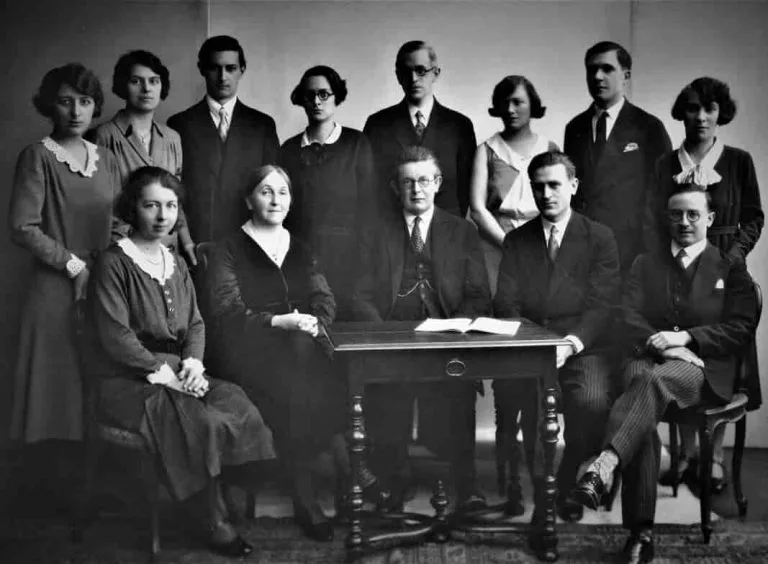
Constructivism is a theory of learning which holds that knowledge is not handed to the learner ready-made but actively built by them. On this view the mind is not a container to be filled with facts; it is a builder that assembles its own understanding by acting on the world, testing ideas against experience, and reorganising what it already knows. Applied to language, constructivism treats knowing a language not as a stock of words and rules poured in from outside, but as a mental model the learner constructs for themselves — which is why this entry borrows Jean Piaget's 1973 claim that language is, in the end, all in the mind.
Constructivism is less a single method than a family of theories that share one commitment: the learner is the active agent of their own learning. Its two great sources are Jean Piaget, who explained how an individual mind builds knowledge through its own development (cognitive constructivism), and Lev Vygotsky, who argued that knowledge is built first between people and only then inside the individual (social constructivism). A third figure, Jerome Bruner, carried these ideas into the classroom and gave teaching its most durable constructivist images — discovery learning, the spiral curriculum and scaffolding. Between them they replaced the behaviorist picture of the learner as a bundle of conditioned habits with a picture of the learner as a thinker who constructs meaning.
Piaget: cognitive constructivism
The Swiss psychologist Jean Piaget (1896–1980) is the founder of what is now called cognitive or psychological constructivism. Trained as a biologist, Piaget approached the mind as a living system that adapts to its environment, and he built his theory from decades of close observation of children — including his own. His central claim is that a child does not think like a small adult: intelligence develops through a fixed sequence of qualitatively different stages, and at each stage the child understands the world in a genuinely different way.
The engine of that development is the schema — a mental structure, or unit of knowledge, that organises experience and guides how a person responds to it. Schemas grow through two complementary processes. In assimilation, new experience is interpreted in terms of an existing schema (a child who knows “dog” may call every four-legged animal a dog). In accommodation, the schema itself is revised when it no longer fits (the child learns that cats, horses and dogs are different, and splits the schema). Learning, for Piaget, is the endless to-and-fro of these two, driven by equilibration — the mind's push to resolve the disequilibrium it feels when experience contradicts what it expected.
Piaget mapped development onto four stages: the sensorimotor stage (birth to about two), in which the infant learns through senses and action and grasps that objects still exist when out of sight; the preoperational stage (about two to seven), in which the child uses symbols and language but not yet consistent logic; the concrete operational stage (about seven to eleven), in which logical thought applies to concrete situations; and the formal operational stage (from about eleven), in which abstract and hypothetical reasoning becomes possible.
On this foundation Piaget built his account of language, set out most sharply in his 1973 contrast with the nativism of Noam Chomsky. For Piaget, language is not a separate innate faculty that switches on by itself; it is a product of general cognitive development. A child cannot use a linguistic concept before the underlying cognitive concept is in place — the ability to talk about an absent object, for instance, rests on the prior achievement of object permanence. Language, on this view, expresses the mental model the child has already constructed; it does not create that model. From it follows a practical lesson Piaget stressed repeatedly: learning by memorising rigid facts is weak and short-lived, because knowledge takes root only when the learner connects it to what they already understand.
Vygotsky: the zone of proximal development and scaffolding
The Soviet psychologist Lev Vygotsky (1896–1934) built the other great branch of constructivism — social constructivism — in a career cut short by tuberculosis at thirty-seven, so that much of his influence came posthumously as his work was translated in the following decades. Where Piaget saw the child as a lone scientist experimenting on the world, Vygotsky insisted that thinking is social before it is individual: every higher mental function, he argued, appears first between people, in shared activity, and only later is internalised by the child. Knowledge is co-constructed, and culture — above all its languages, symbols and tools — supplies the materials.
Language holds a special place in this account. For Vygotsky speech begins as a social, communicative act; it then turns inward, passing through the “egocentric” talk of young children into inner speech, the silent language in which we think. This is a direct clash with Piaget, who read the same egocentric speech as a sign of the child's immaturity — a failure to take another's point of view — soon to disappear. For Vygotsky it does not disappear; it goes underground and becomes the very structure of thought. Thinking, on this view, is language internalised. (Vygotsky set this out in Thought and Language, published in 1934, the year he died.)
His most influential idea for teaching is the zone of proximal development (ZPD): the gap between what a learner can do alone and what they can do with the help of a more knowledgeable other — a teacher, a parent, a more capable peer. Instruction should aim not at what the child has already mastered but at this zone, at what is just out of reach unaided. The temporary support that lets a learner work inside their ZPD later came to be called scaffolding — help that is offered while it is needed and withdrawn as the learner takes over, exactly as building scaffolding is removed once the structure stands. This reverses Piaget's order of priority: for Piaget development sets the pace and teaching must wait for readiness; for Vygotsky good instruction leads development, pulling the learner forward through the ZPD.
Bruner and learning by discovery
The American psychologist Jerome Bruner (1915–2016) was the figure who carried constructivism into education and gave it its working vocabulary. Bruner held that learners construct new ideas by building on their current knowledge, and that they represent the world in three modes that develop in turn: the enactive (knowledge held in action, in what the hands can do), the iconic (knowledge held in images) and the symbolic (knowledge held in language and abstract symbols). Good teaching moves a new idea through these modes in order.
From this came two famous proposals. In The Process of Education (1960) Bruner argued that “any subject can be taught effectively in some intellectually honest form to any child at any stage of development” — the basis of the spiral curriculum, in which the same core ideas are revisited again and again, each time in a more complex and abstract form as the learner is ready for it. And he championed discovery learning: rather than being told a rule, learners are led to find the underlying principle for themselves, because knowledge a person builds is understood and retained far better than knowledge merely received. Bruner did not mean unaided flailing — he favoured guided discovery, and it was in a 1976 study with Wood and Ross that the metaphor of scaffolding for a tutor's structured support was first coined. His work is the practical bridge from Piaget's and Vygotsky's psychology to what actually happens in a classroom.
Constructivism in the language classroom
Translated into language teaching, constructivism changes the basic job description of teacher and learner. If knowledge is built rather than transmitted, then the learner is not an empty vessel waiting to be filled with vocabulary and grammar rules, and the teacher is not a dispenser of correct forms but a designer of experiences from which the learner can construct the language. The learner's developing internal grammar — an evolving mental model, not a copy of the textbook — is the real object of teaching, and the errors a learner makes are read as evidence of the model they are currently building, not merely as faults to be stamped out.
Several now-standard practices follow directly. Scaffolding — modelling, prompts, sentence frames, graded questions — supports learners just above their current level and is faded as they gain control, a classroom application of the ZPD. Pair and group work treats speaking with others not as a reward after learning but as the site where learning happens, since knowledge is co-constructed in interaction. And task-based language teaching gives learners real problems to solve through language — plan a trip, resolve a disagreement, exchange missing information — so that grammar and vocabulary are constructed in the service of a meaningful goal rather than practised in the abstract. This is the direct link to communicative language teaching, whose whole premise — that competence is built by using the language for real purposes — is constructivism applied to a second language.
The approach has a serious critic, and the criticism is worth stating. In an influential 2006 paper, Kirschner, Sweller and Clark argued that minimally guided, pure-discovery instruction can overload a novice's working memory and actually slow learning: beginners, they showed, need substantial guidance and worked examples, not to be thrown in to discover everything unaided. The reply from constructivists is that this attacks a caricature — well-run constructivist teaching is guided, and scaffolding is precisely the structure that manages cognitive load. The upshot for a language learner is a balanced one: active construction is essential, but so is support — construction without scaffolding is just confusion.
What this means for learning a language
The core lesson of constructivism for a learner is that you build the language; no one can install it in you. Rules explained in a grammar book become usable knowledge only when you construct them for yourself through use, which is why sitting through explanations feels so different from actually speaking. Two practical consequences follow. First, new knowledge has to be hooked onto what you already know — Piaget's assimilation — so learning a word or structure inside a context you understand beats memorising it cold; this is the reasoning behind rich, understandable exposure, or comprehensible input. Second, the building happens in use: you construct a language by trying to do things with it and getting support at the edge of what you can already manage, which is the case for a method built on active recall and real practice rather than passive study.
What constructivism warns against is just as useful. Because the model has to be built by the learner, no amount of clear explanation substitutes for the learner's own effort — and because beginners can be overwhelmed, that effort has to be scaffolded, not left to sink-or-swim discovery. The most effective learning sits between the two failures the theory identifies: knowledge poured in from outside that never takes root, and unsupported discovery that overloads and confuses. Build actively, connect to what you know, and lean on support that fades as you grow.
FAQ
What is constructivism in one sentence?
Constructivism is the theory of learning that knowledge is actively built by the learner — by acting on the world and reorganising what they already know — rather than passively received from a teacher, so that understanding a subject, including a language, means constructing a mental model of it for oneself.
What is the difference between Piaget's and Vygotsky's constructivism?
Piaget's cognitive constructivism sees knowledge as built by the individual mind through its own development, in fixed stages, with language a product of underlying cognitive growth; teaching should follow the child's readiness. Vygotsky's social constructivism sees knowledge as built first between people in social interaction and then internalised, with language the central tool of thought; good instruction leads development by working in the zone of proximal development, just beyond what the learner can do alone.
What are the zone of proximal development and scaffolding?
The zone of proximal development (Vygotsky) is the gap between what a learner can do alone and what they can do with help from a more knowledgeable other. Scaffolding is the temporary support — modelling, prompts, sentence frames, graded questions — that lets the learner work inside that zone and is gradually withdrawn as they take over. In language teaching, teaching aimed at the ZPD and faded through scaffolding is a core constructivist technique.
Sources
- Saul McLeod, “Constructivism Learning Theory & Philosophy of Education”, Simply Psychology.
- Saul McLeod, “Piaget's Theory and Stages of Cognitive Development”, Simply Psychology (schemas, assimilation and accommodation, the four stages).
- Saul McLeod, “Vygotsky's Sociocultural Theory of Cognitive Development”, Simply Psychology (the zone of proximal development, inner speech).
- Saul McLeod, “Jerome Bruner's Theory of Cognitive Development”, Simply Psychology (modes of representation, spiral curriculum, discovery learning).
- David Wood, Jerome S. Bruner and Gail Ross, “The Role of Tutoring in Problem Solving”, Journal of Child Psychology and Psychiatry 17 (1976): 89–100 (origin of the term “scaffolding”).
- Paul A. Kirschner, John Sweller and Richard E. Clark, “Why Minimal Guidance During Instruction Does Not Work”, Educational Psychologist 41 (2006): 75–86 (the main critique).