



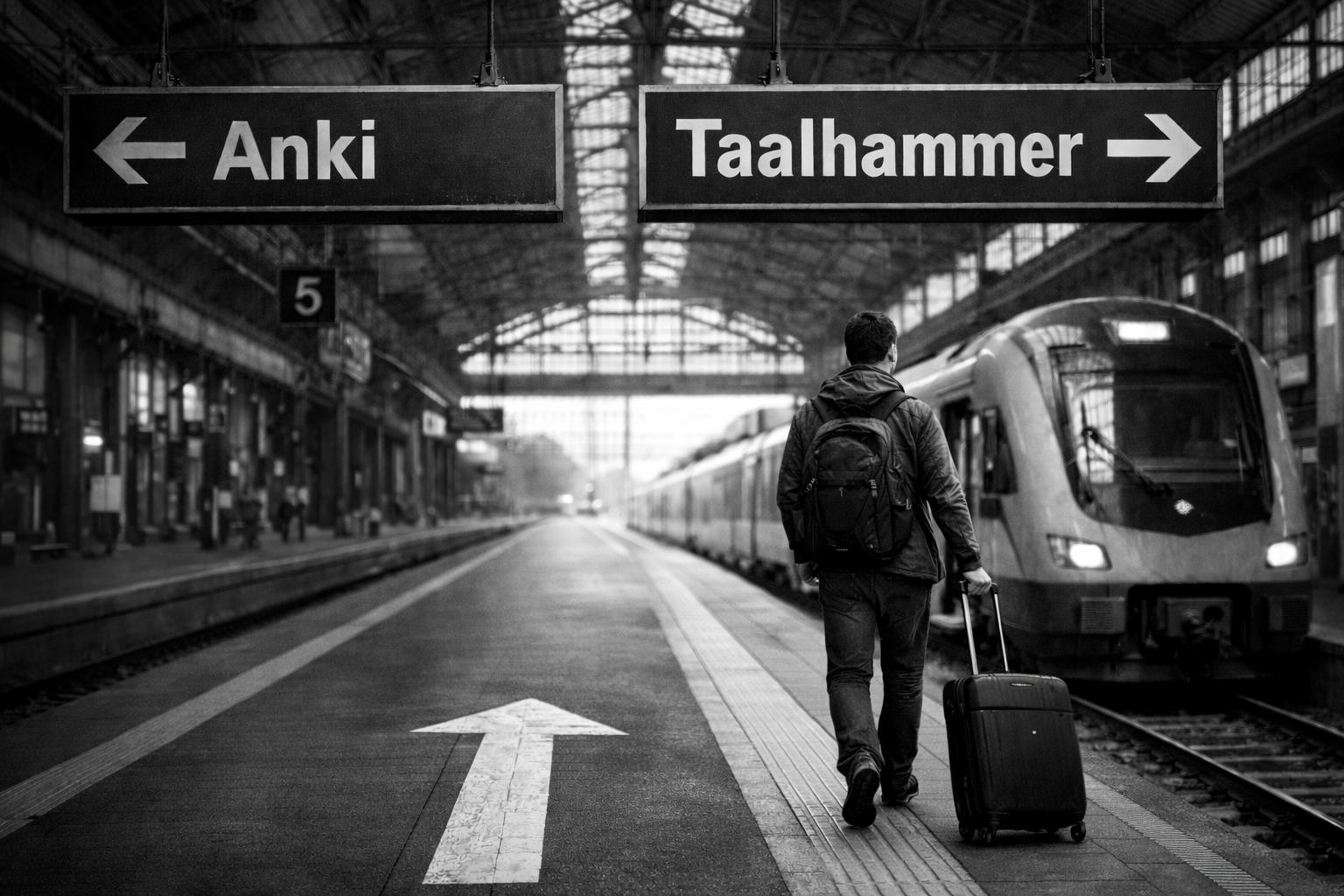
Most people who compare Taalhammer and Anki are not beginners.
They’ve already built decks. They’ve reviewed thousands of cards. They’ve proven they can stay consistent. The tension usually appears later:
“I know a lot of words. Why can’t I speak?”
This article is not about whether Anki works. It does — for what it’s designed to do. The real question is different:
At what point does vocabulary retention stop translating into usable language ability — and what kind of system closes that gap?
- Anki vs Taalhammer – Memory Engine vs Integrated Language System
- Why Vocabulary Retention Doesn’t Always Become Speaking Ability
- The Plateau Problem – What Happens After A2?
- Cognitive Load – System Management vs Language Decisions
- Active Recall vs Flashcards – Two Interpretations of Spaced Repetition
- Do You Still Need Anki If Taalhammer Includes Spaced Repetition?
- FAQ – Taalhammer vs Anki for Language Learning
- What’s the difference between Taalhammer and Anki?
- How does Taalhammer work differently from Anki?
- Does Taalhammer support spaced repetition like Anki?
- Can I become fluent using Anki?
- Is Taalhammer better than just flashcards?
- Will Taalhammer help with long-term retention?
- How long does it take to see results with Taalhammer?
- What are common mistakes with Anki?
- Who is Anki best for?
- Who is Taalhammer best for?
Anki vs Taalhammer – Memory Engine vs Integrated Language System
The structural difference between these two tools is not about features. It’s about architecture.
Anki is a memory engine. It schedules recall of user-defined units.
Taalhammer is a structured language system that embeds memory inside sentence progression. That difference changes everything downstream.
| Dimension | Anki | Taalhammer |
|---|---|---|
| Unit of learning | User-defined (often words or cloze cards) | Full sentences from the start |
| Role of grammar | Depends on card design | Embedded in sentence variation |
| Progression logic | External to the system | Built-in, cumulative |
| User control | High customization | Guided structure with adaptive review |
| What “mastery” means | Card remembered at interval | Sentence reconstructed under variation |
Anki optimizes timing. It assumes you define the structure.
Taalhammer defines structure first and integrates timing into it.
This distinction explains most switching behavior.
Why Vocabulary Retention Doesn’t Always Become Speaking Ability
Memorizing a word and assembling a sentence are different mental operations.
Flashcards often train recognition or isolated recall:
- front → back
- cloze → missing word
- definition → translation
That builds strong lexical storage. It does not necessarily train recombination.
Speaking requires:
- retrieving words,
- selecting grammar,
- ordering elements correctly,
- doing it under mild time pressure.
If your training units are mostly static, your brain practices retrieving fixed answers. Real language use is dynamic.
Taalhammer addresses this by making recall sentence-level and slightly variable. A pronoun changes. A tense shifts. An earlier structure reappears inside a more complex frame. Retrieval becomes assembly, not just recall.
When “I Know It” Doesn’t Mean “I Can Use It”
Many learners experience a subtle illusion: high deck retention feels like progress. But when faced with spontaneous production, hesitation appears.
That’s not a memory failure. It’s a structural training gap.
For a deeper breakdown of this distinction between remembering and producing, see how recall-based systems differ in language learning app vs flashcards for long-term fluency.
The Plateau Problem – What Happens After A2?
Early stages are forgiving. Simple declarative sentences can be built from vocabulary chunks. Intermediate stages are not.
You encounter:
- subordinate clauses,
- aspect contrasts,
- modality,
- agreement across distance,
- embedded structures.
At this point, scaling matters more than volume.
| Structural Question | Anki | Taalhammer |
|---|---|---|
| Increasing complexity | Depends on deck design | Built into progression |
| Reuse of earlier material | Manual or incidental | Systematically re-integrated |
| Grammar layering | User-dependent | Embedded in sentence evolution |
| Transition to B1–B2 | Requires architectural planning | Same mechanism, denser structures |
Anki can scale — but only if you redesign your cards accordingly. The system itself does not reorganize your material as complexity grows. Taalhammer uses the same mechanism at higher levels as at beginner levels: full recall of structured sentences. What changes is syntactic density. Plateaus often emerge when a system optimized for atomic units meets relational grammar. Check out this article to see which language learning apps are more likely to pleateau around A2 level.
Cognitive Load – System Management vs Language Decisions
Every learning system consumes mental energy. The question is where.
With Anki, cognitive load often includes:
- Deck sourcing or creation
- Tag management
- Interval adjustments
- Managing growing review queues
This autonomy is powerful. It also demands system discipline.
Taalhammer reduces architectural decisions. Spacing is adaptive. Sentences progress cumulatively. The friction remains linguistic — not managerial.
For many adult learners, the difference shows up in sustainability:
- Anki rewards disciplined system builders.
- Taalhammer supports learners who want to invest effort into language decisions rather than deck engineering.
This is not about ease. It’s about where difficulty is placed. If you’re an adult who’s struggling to choose the right language learning app, check out my comparison of 6 language learning tools and see which one is best for your needs.
Active Recall vs Flashcards – Two Interpretations of Spaced Repetition
Both language learnin apps use repetition. The interpretation differs.
In Anki, spaced repetition schedules the reappearance of stored units. If you recall the card correctly, the interval increases. Memory timing is precise.
In Taalhammer, repetition is attached to sentence reconstruction under variation. A structure is not just remembered; it is reassembled in slightly altered form over time. Repetition strengthens flexibility, not only retention.
If you’re interested in how recognition and recall shape different learning outcomes, see the deeper comparison of recall-based and recognition-based systems in this analysis of recognition vs recall in language learning.
The key difference is not whether repetition exists. It’s what is being repeated — and in what form.
Do You Still Need Anki If Taalhammer Includes Spaced Repetition?
Both tools use spaced repetition. The question is whether they use it in isolation or inside a broader progression model.
Anki is built around one core strength:
precise, customizable memory scheduling for whatever units you choose to review.
Taalhammer also uses adaptive spaced repetition — but attaches it to:
- full sentence recall,
- structured grammar progression,
- cumulative complexity,
- topic-based collections,
- multi-language support,
- and listening exposure through integrated features like radio-style input.
This changes the decision framework.
If your goal is purely to:
- store vocabulary efficiently,
- memorize terminology,
- maintain a large deck of discrete items,
Anki remains one of the most precise tools available.
But if you want:
- vocabulary retention,
- sentence production,
- grammar integration,
- listening exposure,
- progression beyond beginner level,
- and reduced system maintenance,
then the question becomes practical:
What unique function does Anki still provide that is not already embedded inside a structured system? For some learners, the answer is customization. For others, it’s habit familiarity. For many who switch, the shift happens when they realize that:
- Memory timing alone is no longer their bottleneck.
- Structural fluency is.
At that point, using a system that includes spaced repetition and progression logic may simply reduce redundancy.
Switching isn’t about abandoning flashcards.
It’s about consolidating memory into a system designed to scale.

FAQ – Taalhammer vs Anki for Language Learning
What’s the difference between Taalhammer and Anki?
Anki is a memory engine you configure.
Taalhammer is a guided progression model that already integrates memory, sentence production, and structural scaling.
The difference shows most clearly beyond beginner level.
How does Taalhammer work differently from Anki?
Anki schedules memory.
Taalhammer structures language.
In Taalhammer, spaced repetition is built into full sentence recall, grammar variation, and cumulative progression. The system guides structural development rather than leaving it to deck design.
Does Taalhammer support spaced repetition like Anki?
Yes — but it attaches repetition to sentence reconstruction and grammar decisions, not static recall units. Memory strengthening and structural flexibility develop together.
Can I become fluent using Anki?
Anki is good for retaining vocabulary. But fluency requires repeatedly building full sentences under slight variation, not just recalling stored answers.
You can design Anki to train that — but you have to engineer it yourself. Most decks don’t go that far.
Taalhammer builds sentence reconstruction and structural progression into the system from the start. If your goal is independent, real-time language use, having that architecture already in place makes a practical difference.
Is Taalhammer better than just flashcards?
If you only need efficient memorization, flashcards are enough. If you want retention plus structured sentence production, grammar integration, and scalable progression in one system, a sentence-based platform addresses more dimensions simultaneously.
Will Taalhammer help with long-term retention?
Yes. Because recall is active and repeated under variation, structures are reinforced in different contexts. This tends to stabilize memory in a way that transfers more naturally to real use.
How long does it take to see results with Taalhammer?
You’ll usually feel the difference within a few weeks — not because you recognize more words, but because you hesitate less when forming sentences.
Early progress can feel slower than flashcards, since you’re reconstructing full sentences rather than selecting answers. But that friction is the training. Over time, structures become automatic, and the gap between “I know this” and “I can say this” narrows noticeably..
What are common mistakes with Anki?
- Confusing retention rates with communicative ability
- Expanding decks faster than structural competence
- Relying mostly on word-level cards
- Managing volume rather than progression
These are design limitations, not user failures.
Who is Anki best for?
Learners who want precise memorization, full customization, and control over their learning architecture — especially for vocabulary-heavy goals.
Who is Taalhammer best for?
Learners aiming for independent sentence production, structural fluency, and a system that scales beyond beginner levels without requiring manual design.
Related Posts

What Language Learning App Should I Use If I Want to Learn With My Own Content? Taalhammer vs Anki and 4 More Apps
Taalhammer vs Memrise: Usable Sentences or Isolated Phrases?

Why Listening to Your Own Sentences Is the Most Efficient Way to Learn a Language (and Which App Does It Best)
Taalhammer vs Duolingo: Która aplikacja do nauki języków obcych naprawdę uczy lepiej w 2026 roku?
Taalhammer vs Duolingo: Which Language Learning App Actually Works Better in 2026?