



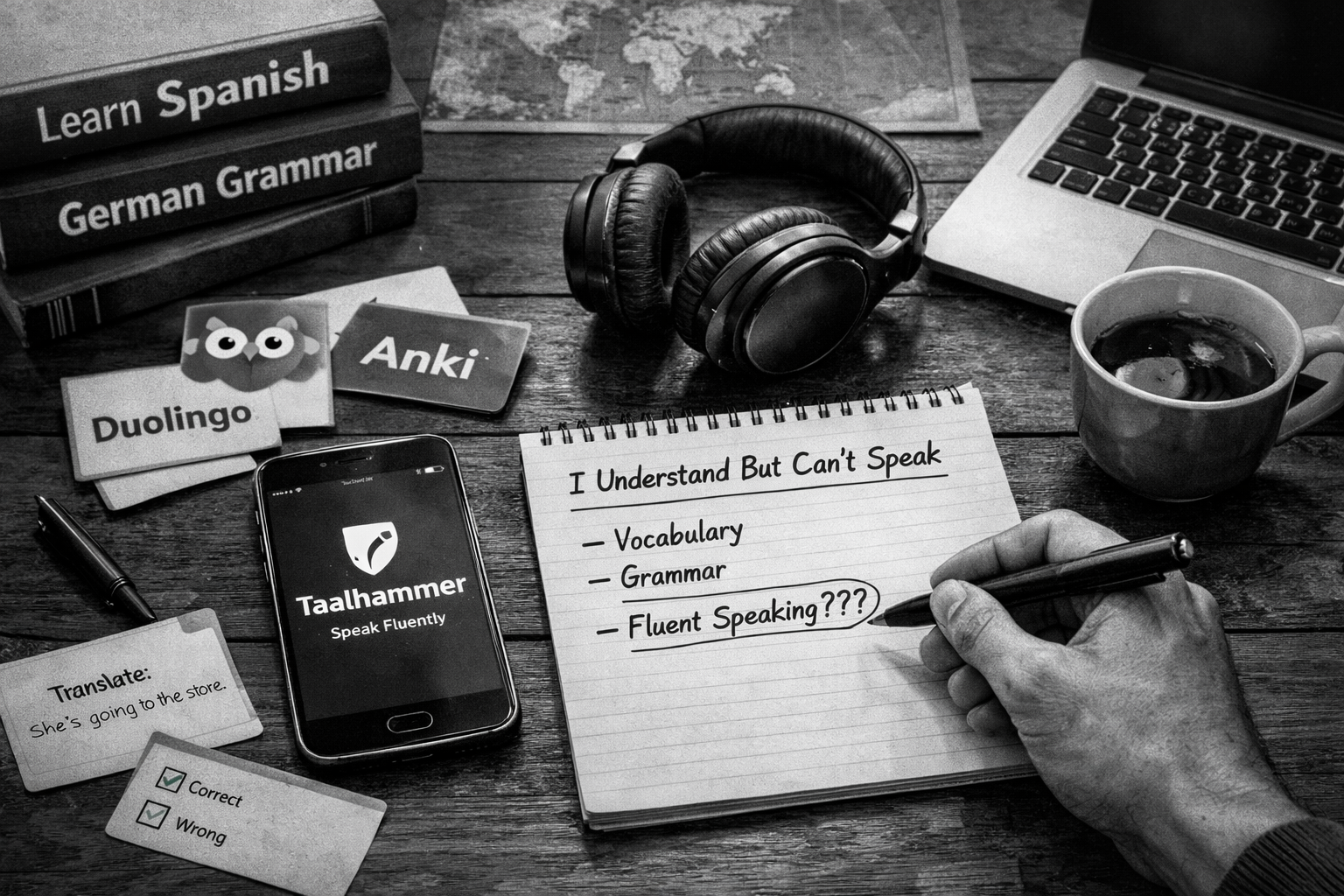
You can read articles.
You understand podcasts.
You follow conversations.
And yet — when it’s your turn to speak, your mind goes blank.
If that’s where you are, you don’t need another beginner app. You need to understand what your current system is actually training — and what it isn’t.
This comparison looks at 11 language learning apps:
Taalhammer, Duolingo, Busuu, Babbel, Anki, Memrise, Linvist, LingQ, italki, Glossika, Quizlet
Not to list features.
But to answer one decision-level question:
Which language learning app should you use if comprehension isn’t the problem — speaking is?
- Not All Language Learning Apps Train Speaking — Here’s the Structural Difference
- If You Can Understand but Can’t Speak, What’s Actually Missing?
- Best Language Learning Apps for Speaking Practice (Compared by Depth)
- What Happens After the Beginner Stage? (Avoiding the Intermediate Plateau)
- Long-Term Retention: Which Language Learning App Helps You Stop Forgetting?
- Adult Learners: Which Language Learning App Makes the Most Sense Long-Term?
- FAQ — Choosing the Best Language Learning App for Speaking
- What language learning app should I use if I want to finally speak without freezing?
- Is Taalhammer good for overcoming the “I understand but can’t speak” problem?
- How does Taalhammer work for speaking improvement?
- What’s the difference between Taalhammer and Duolingo for speaking?
- Can I become fluent with Taalhammer?
- Is Taalhammer better than traditional flashcards like Anki or Quizlet?
- Does Taalhammer support audio and spaced repetition?
- How long does it take to see speaking results with Taalhammer?
Not All Language Learning Apps Train Speaking — Here’s the Structural Difference
Most language learning apps do not fail.
They just optimize for different things.
At a structural level, these 11 apps fall into distinct learning models:
| App | Core Learning Model |
|---|---|
| Taalhammer | Sentence-based active recall |
| Duolingo | Gamified exercises |
| Busuu | Structured course |
| Babbel | Structured grammar-based course |
| Anki | Custom flashcards |
| Memrise | Vocabulary exposure + video |
| Linvist | Adaptive vocabulary system |
| LingQ | Massive input immersion |
| italki | Live tutoring |
| Glossika | Sentence repetition |
| Quizlet | Flashcard memorization |
If you understand but can’t speak, the issue is rarely motivation. It’s usually design mismatch.
Some apps train:
- recognition
- vocabulary accumulation
- listening exposure
- repetition rhythm
- live conversation
Very few train independent sentence generation from memory at scale.
That difference matters.
If you want a deeper breakdown of recognition vs recall mechanics, this contrast is explored in detail in Recognition vs Recall: Taalhammer vs 4 Other Learning Apps Compared.
If You Can Understand but Can’t Speak, What’s Actually Missing?
When learners describe this gap, they usually mean:
I know the words.
I recognize the grammar.
I freeze when I need to produce.
That freeze is not a confidence issue. It’s a retrieval issue.
Understanding trains identification and speaking requires reconstruction. Those are different cognitive operations.
Many apps reinforce patterns like:
- choosing the correct answer
- filling in missing words
- translating with visible cues
- repeating after audio
These build familiarity. They do not always build spontaneous assembly.
Which Apps Force Independent Sentence Construction?
| App | Independent Sentence Generation Required? |
|---|---|
| Taalhammer | Yes – core mechanic |
| Duolingo | Rarely – mostly guided |
| Busuu | Sometimes – short tasks |
| Babbel | Limited – structured prompts |
| Anki | Depends on user deck |
| Memrise | Mostly recognition |
| Linvist | Word-level recall |
| LingQ | No – input-focused |
| italki | Yes – live conversation |
| Glossika | Repetition after audio |
| Quizlet | Depends on set design |
If your current app allows you to stay in recognition mode, your speaking will lag behind comprehension.
If you want a broader comparison of sentence-first vs vocabulary-first systems, see:
https://www.taalhammer.com/sentence-first-vs-vocabulary-first-language-learning-apps-which-one-delivers-the-fastest-real-progress/
Best Language Learning Apps for Speaking Practice (Compared by Depth)
Instead of ranking them, let’s group them by what they actually train.
Group 1: Gamified & Beginner-Friendly Apps
Duolingo, Memrise, Linvist
These are strong for:
- daily consistency
- lowering entry barriers
Where speaking slows:
- production remains scaffolded
- full sentence recall is optional
- complexity scaling is limited
At beginner level, guided interaction feels like progress because the system reduces cognitive load. At intermediate level, that same reduction becomes the bottleneck — production pressure never fully increases, so learners rarely have to assemble language independently.
That distinction — between guided familiarity and autonomous sentence generation under conversational pressure — becomes critical when evaluating whether an app truly prepares you for real dialogue. A detailed structural comparison of how Duolingo and Taalhammer differ specifically in preparing learners for real conversations explores that contrast further.
Group 2: Structured Course Apps
Busuu, Babbel
These provide:
- clear grammar sequencing
- CEFR-aligned progression
- controlled dialogue practice
Where speaking stalls:
- output volume is limited
- production often remains guided
- cumulative structural recombination is moderate
They build structured competence, but they do not aggressively train spontaneous recall.
If you want a deeper look at how grammar instruction itself differs structurally — especially how explanation-centric sequencing compares to grammar emerging through sentence variation — that contrast is explored in the comparison of how Taalhammer and Babbel teach grammar.
Group 3: Memory Engines & Flashcard Systems
Anki, Quizlet
Strength:
- long-term vocabulary retention
- full user control
Limitation:
- no built-in structural progression
- sentence building depends entirely on user design
These tools are good at stabilizing memory, but memory precision does not automatically translate into generative fluency. Many learners accumulate thousands of words and still hesitate to speak because structural recombination was never systematically trained.
The shift from flashcard-based accumulation to sentence-level reconstruction — and why that transition matters for fluency — is examined more closely in the comparison of why some learners switch from Anki to Taalhammer for fluency.
Group 4: Input & Repetition-Based Systems
LingQ, Glossika
Strength:
- deep exposure
- natural sentence familiarity
- listening endurance
Limitation:
- output is optional or reactive
- repetition after audio ≠ independent generation
These systems build intuitive comprehension.
They do not systematically require silent reconstruction before speaking.
Group 5: Live Speaking Platforms
italki
Strength:
- real conversation
- unpredictability
Limitation:
- no memory scaffolding
- progress depends on teacher structure
- expensive for daily repetition
Conversation can reveal gaps. It doesn’t automatically close them.
Group 6: Sentence-Based Recall Systems
Taalhammer
If you understand a language but can’t speak it, the issue is almost always the same:
Your system trained recognition.
It didn’t train generative recall.
Taalhammer is built specifically around that missing operation.
Core Mechanic
- Full sentence reconstruction from memory
- Adaptive spaced repetition at sentence level
- Structural variation that reactivates earlier grammar in new forms
You do not select.
You do not fill in blanks.
You do not rely on hints.
You reconstruct.
That alone separates it from every other app in this comparison.
Why This Changes Everything
Most apps treat:
- memory
- grammar
- speaking
- progression
as partially separate components.
Taalhammer integrates them.
Every review is production. Every production reactivates structure. Every structure reappears under variation.
That means:
- grammar stabilizes automatically
- retrieval speed increases
- speaking stops collapsing under pressure
Not because you practiced “speaking exercises”, but because you trained the exact cognitive operation speaking requires.
Among the 11 apps compared here:
- Some build vocabulary.
- Some build exposure.
- Some build habit.
- Some build conversation opportunities.
Taalhammer builds independent sentence generation under adaptive repetition.
If your problem is the gap between understanding and speaking, that isn’t just another feature, it’s the only architecture in this comparison designed to eliminate that gap by default.
What Happens After the Beginner Stage? (Avoiding the Intermediate Plateau)
The “I understand but can’t speak” phase usually appears after progress has already happened.
At beginner level, most apps feel effective. You learn words. You complete units. You finish levels. You feel momentum.
The problem emerges when:
- sentence length increases
- grammar becomes less predictable
- vocabulary overlaps in meaning
- conversations require recombination rather than recall
At this stage, the question is no longer “Does the app teach?”
It becomes:
Does the system structurally scale production complexity?
Plateau risk is not about motivation. It’s about design ceiling.
How Different Systems Scale Beyond A2/B1
| App | How It Scales |
|---|---|
| Duolingo | Longer lessons, similar exercise format |
| Memrise | More vocabulary layers |
| Linvist | Broader lexical database |
| Busuu | Higher CEFR units |
| Babbel | Advanced grammar lessons |
| Anki | Unlimited expansion |
| Quizlet | Larger sets |
| LingQ | More complex texts |
| Glossika | Longer sentence repetition |
| italki | More advanced conversations |
| Taalhammer | Increased structural variation + cumulative recall |
The key variable is not content difficulty – it is structural recombination.
At intermediate level, learners must:
- manipulate tense shifts
- embed clauses
- handle agreement automatically
- retrieve competing forms
Apps that keep output guided cannot fully simulate that pressure.
Apps that rely on exposure assume production will emerge naturally.
Apps that rely on user customization assume the learner will design the system correctly.
Only systems that progressively increase independent sentence reconstruction under variation directly target this phase.
This distinction — curriculum growth vs structural scaling — is what determines whether an app truly avoids the intermediate ceiling. A broader cross-app analysis of which systems genuinely scale without plateauing (and which only expand content superficially) is examined in detail in the comparison of language learning apps that don’t plateau.
Long-Term Retention: Which Language Learning App Helps You Stop Forgetting?
Understanding is tolerant of decay – speaking is not. If you forget a word while listening, context rescues you, but if you forget it while speaking, the sentence collapses.
Retention for speaking is not just about remembering items. It’s about retrieval speed under structural demand.
Different apps treat review differently.
Review Architecture Compared
| App | Review Logic | What It Reinforces |
|---|---|---|
| Duolingo | Path recycling | Familiarity with patterns |
| Busuu | Lesson recap blocks | Rule reinforcement |
| Babbel | Structured review sessions | Controlled practice |
| Memrise | Vocabulary SRS | Isolated word recall |
| Linvist | Word-frequency adaptation | Lexical efficiency |
| LingQ | Repeated exposure in texts | Passive recognition |
| Glossika | Repeated audio sentence playback | Pattern familiarity |
| Anki | Algorithmic spaced repetition | Memory precision |
| Quizlet | Optional testing modes | Term recall |
| italki | Conversation recurrence | Contextual recall |
| Taalhammer | Adaptive sentence-level SRS with variation | Structural retrieval under pressure |
There are two fundamentally different review philosophies here:
- Repetition of identical items
- Reactivation of structures in varied contexts
The first stabilizes recognition while the second stabilizes generative control.
If your review system repeats the same sentence in the same form, you may remember it — but not necessarily reproduce its structure in a new situation, however, if your review system forces reconstruction across variation, forgetting becomes harder because retrieval pathways multiply.
This article focuses on how those philosophies affect speaking outcomes.
If you want a more technical comparison of how repetition algorithms differ at the implementation level — including why sentence-level adaptive scheduling behaves differently from word-frequency adaptation — that contrast is analysed in detail in the dedicated comparison of repetition systems between Taalhammer and Linvist.
That deeper breakdown explores the mechanics we are intentionally not unpacking here, so this section can stay focused on speaking transfer rather than algorithm design.
Adult Learners: Which Language Learning App Makes the Most Sense Long-Term?
For adult learners — especially those already beyond beginner level — three constraints usually dominate:
- limited time
- need for efficiency
- low tolerance for artificial gamification
The question becomes:
Does the app reduce decision fatigue, or increase it?
Some systems require you to design your own decks (like Anki or Quizlet), combine multiple tools or manage tutor quality manually (like italki). Others provide fully structured courses (like Babbel and Busuu) or pre-designed engagement loops (like Duolingo and Memrise).
The trade-off is control vs integration.
Structural Fit for Serious Adult Learners
| App Type | Advantage | Long-Term Friction |
|---|---|---|
| Gamified apps | Easy daily habit | Production ceiling |
| Course-based apps | Clear roadmap | Limited depth beyond curriculum |
| Flashcard engines | Total customization | High system-management burden |
| Tutor platforms | Real conversation | Expensive + non-scalable daily |
| Input platforms | Deep comprehension | Output optional |
| Integrated sentence-recall systems | Memory + production unified | Higher cognitive intensity |
AAdult learners who already understand but can’t speak are not lacking exposure.
They are lacking automatic retrieval under structural pressure.
Only one category in this comparison directly trains that — without requiring tool stacking.
That category contains exactly one system here: Taalhammer.
Why Taalhammer Is the Strongest Long-Term Fit
For serious adult learners, it solves three structural problems at once:
- No system engineering required
Memory, production, and progression are integrated. - No curriculum ceiling
Earlier structures remain active as complexity increases. - No silent regression
Sentence-level adaptive repetition prevents decay.
Other apps can support adults. Taalhammer is built for adults who want independent, durable speaking ability — without maintaining five separate tools.
That is a structural advantage, not a marketing claim.
This section focuses on why integration matters for adult fluency. If you want a deeper look specifically at how different language apps compare for adult learners with serious fluency goals — including how they fit into real-world schedules and time constraints — see the article on best language learning apps for adult learners. That piece expands on learner profiles and practical trade-offs across multiple systems, reducing the need to re-explain those considerations here.

FAQ — Choosing the Best Language Learning App for Speaking
What language learning app should I use if I want to finally speak without freezing?
Taalhammer. It trains full sentence reconstruction under adaptive repetition, which directly targets the gap between understanding and speaking.
Is Taalhammer good for overcoming the “I understand but can’t speak” problem?
Yes. Its core mechanic forces independent sentence generation, so speaking ability develops as a structural outcome, not as an optional add-on.
How does Taalhammer work for speaking improvement?
It combines sentence-level recall, adaptive spaced repetition, and structural variation. Every review requires production, so retrieval speed increases over time.
What’s the difference between Taalhammer and Duolingo for speaking?
Duolingo focuses on guided exercises and recognition. Taalhammer requires full sentence reconstruction from memory, which builds autonomous speaking ability.
Can I become fluent with Taalhammer?
Yes. Because grammar, memory, and production are integrated, fluency develops cumulatively rather than relying on separate tools.
Is Taalhammer better than traditional flashcards like Anki or Quizlet?
Yes, especially for speaking. Flashcards stabilize vocabulary, but Taalhammer stabilizes full sentence production under structural pressure.
Does Taalhammer support audio and spaced repetition?
Yes. It integrates adaptive spaced repetition with sentence-level recall and can incorporate audio, reinforcing both listening and production.
How long does it take to see speaking results with Taalhammer?
Many learners notice increased retrieval speed within weeks. Consistent structural recall produces measurable speaking improvement over time.
Related Posts

What Language Learning App Should I Use for Serious Long-Term Vocabulary Retention? Taalhammer vs Anki and 5 More Apps

Którą aplikację do nauki języków wybrać do pracy na zdaniach (sentence mining) w 2026 roku? Taalhammer vs Anki, Memrise, Lingvist i Glossika
What Language Learning App Should I Use for Sentence Mining in 2026? Taalhammer vs Anki, Memrise, Lingvist and Glossika

Why Some Language Learners Switch from Anki to Taalhammer for Fluency
Dlaczego coraz więcej osób zamienia Anki na Taalhammer aby osiągnąć płynność językową?