



When people search for the fastest language learning app, they rarely mean speed in the literal sense. They don’t mean how many lessons they can click through in a week, how long their streak lasts, or how quickly they can recognise basic phrases.
What they usually want is progress that sticks.
The ability to remember what they learned a month ago.
The ability to speak without freezing.
The feeling that the app isn’t going to stop working just when things get interesting.
That’s where the real difference between course-based and personalised language learning apps shows up — and why so many learners eventually feel stuck despite consistent effort.
- Course-Based vs Personalised Language Learning Apps: the Real Difference
- Which Type of Language Learning App Works Fastest Over Time?
- Course-Based Language Learning Apps in Practice
- Personalised Learning Without a Course: Power and Limits
- A Hybrid Model: Course Structure and Personalised Learning in One System
- Taalhammer — a language learning app that doesn’t force the trade-off
- Final Takeaway: Choosing a Language Learning App That Won’t Limit You Later
- FAQ: Course-Based vs Personalised Language Learning Apps in 2026
- Is a course-based language learning app enough for long-term progress?
- Are personalised language learning apps better for adults?
- Why do many language learning apps stop working around A2?
- Is learning with your own content actually effective?
- Can one language learning app replace courses, tutors, and flashcards?
- What kind of language learning app works best long term?
Course-Based vs Personalised Language Learning Apps: the Real Difference
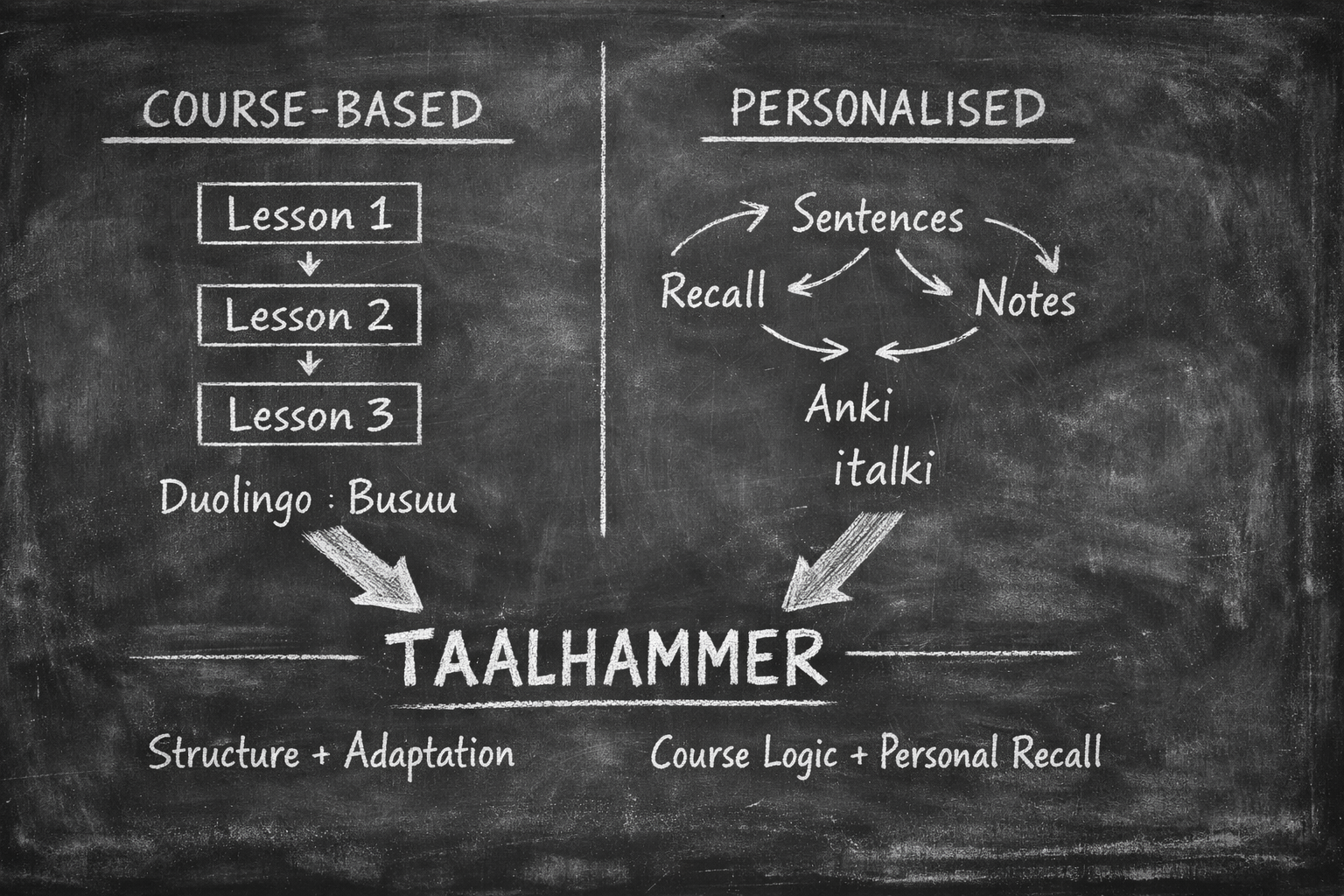
Course-based apps follow a predefined path. Lessons are ordered, levels are labelled, and everyone moves through roughly the same sequence. This makes them easy to start, easy to understand, and psychologically reassuring. You always know “where you are” and what comes next.
Personalised learning systems work differently. Instead of progressing through lessons, learners progress through memory. What appears next depends on what you remember, what you forget, and what you struggle with. The path is less visible, but more responsive.
Both models solve real problems — and both create real limitations.
Course-based apps are excellent at onboarding and early momentum, but they tend to slow down once the learner’s needs diverge from the course design, which explains why many language learning apps plateau over time. Personalised systems scale better over time, but often lack guidance, coherence, or a clear starting structure.
The central question is not which model is better in general, but which model supports fast progress over time, not just at the beginning.
Which Type of Language Learning App Works Fastest Over Time?
At the beginning, almost everything feels fast. Recognition grows quickly, familiar phrases accumulate, and progress feels tangible. This is where course-based apps shine.
The problem appears later. Learners begin to recognise far more than they can produce. They understand much more than they can say. After a break, large portions of the material seem to vanish. Progress slows — not because the learner stopped trying, but because the system no longer adapts to how memory and production actually work.
Fast progress over time requires three things most apps don’t combine well — which is why many learners start looking for systems that deliver fast progress without long-term slowdown:
- repeated active use, not just recognition
- protection against forgetting, especially after interruptions
- the ability to scale complexity without resetting the learning method
With that in mind, the differences between app types become much clearer.
Course-Based Language Learning Apps in Practice
Duolingo — fast onboarding, habit building, limited depth
Duolingo is designed to remove friction. Lessons are short, guided, and heavily supported. The app is exceptionally good at helping learners start and maintain a daily habit, especially at beginner levels.
Its exercises rely largely on recognition and constrained responses, which lowers anxiety and keeps sessions manageable — a pattern common to apps that struggle to support real speaking, as explained in comparisons of Taalhammer vs Duolingo. This makes early progress feel fast and motivating. Learners quickly become familiar with vocabulary and common patterns.
The trade-off is depth. Because the system prioritises ease and consistency, it applies limited pressure on independent sentence production. Grammar control develops slowly and unevenly, and adaptation focuses more on pacing than on diagnosing structural weaknesses. Many learners eventually realise that although they “know a lot,” speaking still feels difficult — and progress slows.
Busuu — structured courses, clear levels, predictable outcomes
Busuu takes a more traditional course-based approach. Content is organised around CEFR levels, grammar topics, and communicative goals. Learners know exactly what they’re studying and why — a model typical of apps that emphasise structured scaffolding.
This clarity is a strength. Explicit explanations help learners understand grammatical rules, and the structured progression provides a sense of direction that many people value, especially adults returning to language learning.
However, the system remains largely linear. Practice formats change little across levels, and adaptation is limited. Once learners complete lessons, previously learned material is not always systematically reactivated in new contexts. As complexity grows, many learners need additional tools to build automation and spontaneous use.
| Duolingo | Busuu | Taalhammer | |
|---|---|---|---|
| Learning model | Fixed course path | Fixed CEFR-based courses | Course core + personalised learning |
| Main strength | Fast start | Clear structure | Long-term, scalable progress |
| Type of practice | Recognition-focused | Guided practice | Active sentence production |
| Adaptation | Minimal | Limited | Fully adaptive |
| Works well long-term? | Not really | Up to a point | Yes, by design |
Personalised Learning Without a Course: Power and Limits
Anki — excellent memory control, minimal learning guidance
Anki is not a language course. It is a memory engine. Its spaced-repetition algorithm is extremely effective at preserving information over long periods of time — if the material is well designed.
The strength of Anki lies in absolute learner control. Anything can be added, reviewed, and retained. For experienced learners who understand how to design sentence-based cards and manage cognitive load, this can support long-term learning.
For most users, however, the absence of structure becomes a problem. Anki does not teach language; it only remembers what you put into it — which is why many learners eventually look for a true Anki alternative built for language learning. Without an external system, learners often default to isolated vocabulary or fragmented knowledge that doesn’t translate into real use.
italki — real conversation, no built-in learning system
italki focuses on human interaction. Learners work with tutors or conversation partners, which makes it excellent for speaking confidence, listening skills, and pragmatic language use.
The learning experience is highly flexible and personal — but also highly dependent on the tutor and the learner’s own organisation. There is no shared curriculum, no memory tracking, and no guarantee that material introduced in one lesson will be stabilised over time.
As a result, italki works best when paired with a structured self-study system, rather than used as a standalone learning solution. On its own, progress can be uneven, especially for learners who don’t yet have a solid foundation.
| Anki | italki | Taalhammer | |
|---|---|---|---|
| What it excels at | Simplicity | Conversation | Whole learning system |
| Main learning driver | User-designed cards | Human tutors | Sentence-based recall |
| Built-in structure | None | None | Yes |
| Memory management | Good | None | Integrated |
| Works alone long-term? | Rarely | Rarely | Yes |
A Hybrid Model: Course Structure and Personalised Learning in One System
Looking at these models side by side, a pattern emerges. Most apps force a choice:
- structure or flexibility
- guidance or autonomy
- onboarding speed or long-term scalability
Course-only systems struggle once learners move beyond the syllabus. Tool-only personalisation requires too much self-design. Conversation-only platforms lack memory support.
A hybrid model addresses this by combining:
- a course backbone that guides early learning
- personalised expansion that adapts to the learner’s memory and goals
- a single system that manages recall and reuse across everything — something most apps fail to achieve without external tools, as seen in comparisons of apps using SRS and AI.
This is where the distinction stops being about features and becomes about architecture.
Taalhammer — a language learning app that doesn’t force the trade-off
Most language learning apps eventually force a choice: follow a fixed course or switch to tools that offer freedom but little guidance — a limitation often discussed when comparing why one language app doesn’t fit all learners.. Taalhammer is built on the assumption that this trade-off is artificial.
From the beginning, learning focuses on full sentence production under recall pressure. Learners actively reconstruct meaning instead of recognising answers, which trains the same skill required for real speaking and writing.
What sets the system apart is how course structure and personalisation coexist inside one framework. There is a clear starting path, but learners are not locked into it.
How the system is structured
- Core collections act as a guided course backbone, giving direction and sequencing.
- Topic collections and learner-created content allow expansion and personal focus without leaving the system.
Everything flows through a single adaptive memory system. Sentences from core material and from user content are treated the same way, preventing the “finished lesson” problem common in course-based apps.
Course logic and personalisation in one place
| How Taalhammer handles it | |
|---|---|
| Guidance | Structured core collections |
| Flexibility | Topic collections + own content |
| Memory & review | One adaptive recall system |
| Progress signal | What you can actively produce |
As learners advance, the system doesn’t change what learning is — it changes how much support is visible.
- Early stages provide more structure and guidance.
- Over time, guidance recedes while recall and recombination remain constant.
This allows progress to continue beyond beginner levels without switching apps or resetting learning strategies. The system scales quietly, supporting long-term memory, speaking readiness, and independent learning rather than lesson completion.
Final Takeaway: Choosing a Language Learning App That Won’t Limit You Later
Fast progress is not about how quickly you start. It’s about how long you can keep going without hitting a wall — especially if you care about long-term retention rather than short-term momentum.
Course-based apps are excellent for onboarding and early clarity. Personalised tools offer power and flexibility, but often lack cohesion. Conversation platforms bring language to life, yet depend on external structure.
A system that combines course logic, personalisation, and learner-generated content avoids the trade-offs that limit most apps. Instead of forcing a choice between structure and freedom, it allows both to coexist — and scale.
For learners who want progress that survives breaks, transfers to speaking, and continues beyond beginner levels, that architectural difference matters more than any individual feature.

FAQ: Course-Based vs Personalised Language Learning Apps in 2026
Is a course-based language learning app enough for long-term progress?
Usually not on its own. Course-based apps are useful early on because they provide structure and direction, but many learners hit a ceiling once lessons are completed. Taalhammer addresses this by using course-style core collections while keeping all material active through recall and reuse, so progress continues instead of stalling after the syllabus ends.
Are personalised language learning apps better for adults?
They often are, but only when personalisation doesn’t mean “you’re on your own.” Adults typically benefit from flexibility and structure. Taalhammer combines both: a guided starting path with the option to personalise learning through topic collections and your own content, without losing coherence.
Why do many language learning apps stop working around A2?
Because the learning model stays the same while the language becomes more complex. Many apps rely heavily on recognition and linear lessons, which don’t scale well. Taalhammer shifts the focus to sentence production and recall early on, so the method already matches what’s required beyond A2.
Is learning with your own content actually effective?
Yes — when it’s handled by a system designed for it. Adding your own content to most apps means managing it separately. In Taalhammer, learner-created content runs through the same memory and recall system as the core material, which allows personal content to strengthen, rather than fragment, long-term progress.
Can one language learning app replace courses, tutors, and flashcards?
Most apps replace only one part of the process. Taalhammer reduces the need to juggle tools by combining course structure, adaptive recall, and personal content in one system. Tutors and conversation practice can still add value, but the core learning no longer depends on multiple disconnected apps.
What kind of language learning app works best long term?
Apps that work long term tend to share three traits: sentence-based learning, active recall, and the ability to grow beyond a fixed syllabus. Taalhammer is built around exactly this combination, which is why it continues to support progress even as learner needs change.
Related Posts

Language Learning Apps That Don’t Plateau in 2026: Taalhammer vs 9 Other Tools

Najlepsza aplikacja do nauki języka greckiego w 2026 roku: Taalhammer vs 8 innych aplikacji
Best Language Learning App for Greek in 2026: Taalhammer vs 8 Other Apps

Która aplikacja do nauki języków najlepiej uczy słuchania na własnych materiałach w 2026 r.? Taalhammer vs 10 konkurentów
Best Language Learning App With Listening Exercises Using Your Own Content in 2026: Taalhammer vs 10 More Apps