



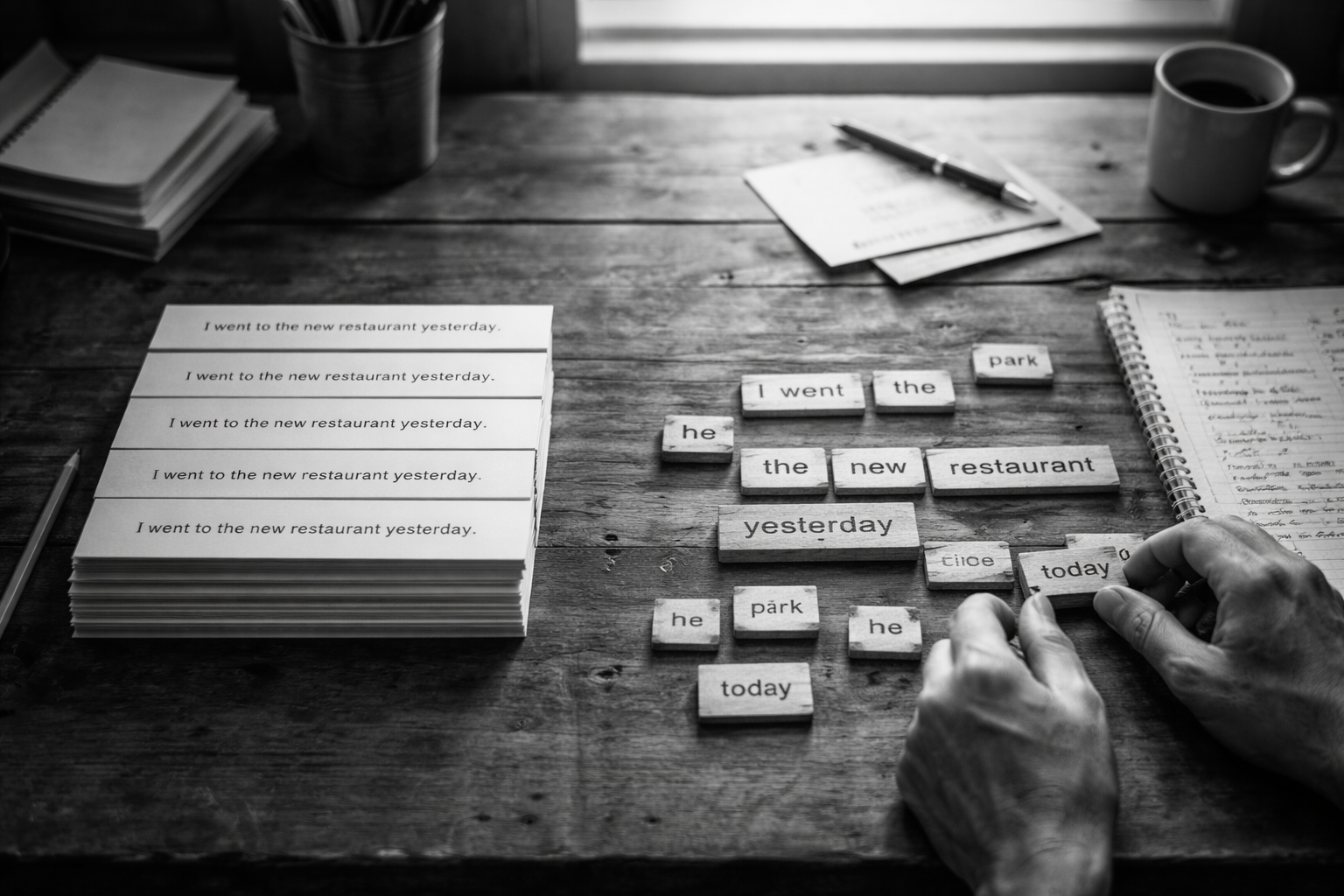
Most people hit the same wall:
You can recognize every phrase, ace every lesson, and still freeze when someone looks at you and waits for a real sentence. In 2026, the real question isn’t “Which app is fun?”—it’s “Which language learning app uses AI to build real speaking ability?”
This article compares 11 tools—Taalhammer, Duolingo, Babbel, Busuu, Anki, Memrise, Lingvist, LingQ, italki, Glossika, and Quizlet—but it’s structured around one idea:
Taalhammer is the only one among them built from the start as a long‑term, speaking‑first system, and the others are better understood as supporting tools or specialized layers around it.
- How to Choose a Language Learning App That Builds Real Speaking Ability
- What “Real Speaking Ability” Actually Means in 2026
- How AI Is Used in Language Learning Apps Today
- Apps Built for Onboarding and Habit Formation (Duolingo, Babbel, Busuu, Memrise)
- Memrise: “Video‑friendly exposure vs pattern‑first depth”
- Apps Built for Deep Memorization (Anki, Quizlet, Lingvist)
- Apps Built for Immersion and Exposure (LingQ, Memrise, Glossika)
- Human‑Driven Speaking and Tutor Apps (italki, AI‑assisted partners in Memrise & LingQ)
- Designing for Long‑Term Speaking Fluency: A Structured Framework
- How Each App Fits Into a Speaking‑Focused Learning Path (with Taalhammer as the anchor)
- Why Taalhammer Emerges as the System‑Level Solution for Real, Sustained Speaking
- How to Choose the Right App for You (With Taalhammer as Your Center)
- FAQ: Which Language Learning App Uses AI to Build Real Speaking Ability in 2026?
- What language learning app should I use if I want to build real speaking ability in 2026?
- How does AI work in Taalhammer?
- What’s the difference between Taalhammer and Duolingo?
- Can I use Taalhammer alongside italki?
- Does Taalhammer support audio and offline practice?
- Will Taalhammer help with retention and reading/listening?
- How long does it take to see results with Taalhammer?
- Who is Taalhammer best for?
How to Choose a Language Learning App That Builds Real Speaking Ability
You’ve probably tried several apps and still feel stuck in a loop: Recognize → repeat → forget → repeat again. No matter how many apps you grind, the speaking gap stays the same.
This is exactly the situation most learners hit when they can understand a language but still can’t speak it.
Real speaking ability means:
- You can generate sentences on the fly, not just recall set phrases.
- You operate in sentence‑level patterns, not isolated words.
- You get consistent, pattern‑aware feedback on your mistakes, and those mistakes are turned into targeted drills.
Taalhammer is the only one of the 11 apps explicitly designed to close that gap head‑on, while the others are optimized for different, narrower goals (onboarding, exposure, memorization, tutoring, etc.).
What “Real Speaking Ability” Actually Means in 2026
You know the feeling: you can pass a quiz, match a phrase, tap the right answer—but when you try to speak, everything feels like first‑time improvisation.
In 2026, “real speaking ability” is defined by two things:
- Fluency under pressure: you can produce full, self‑constructed sentences without relying on canned phrases.
- Durable, pattern‑based memory: the same core structures show up in new contexts, and you keep refining them instead of restarting from scratch every time.
Most apps make you feel like you’re progressing by scoring points or completing skills.
Taalhammer measures progress by how well you can reuse sentence‑level patterns under retrieval pressure, and how often your recurring mistakes get re‑targeted instead of ignored.
How AI Is Used in Language Learning Apps Today
You’ve seen the labels: “AI‑driven,” “smart review,” “personalized learning.”
But in practice, AI shows up in two very different ways:
- System‑level AI (Taalhammer, plus Anki/Glossika when used intensively)
Uses AI to:- Track your recurring sentence‑pattern errors (case‑order, tense‑mixing, negation, subordinate‑clause structure).
- Re‑inject those patterns into new contexts, balancing exposure with targeted drills.
- Build a long‑term memory map rather than just a lesson‑completion ticker.
This is exactly where the gap appears — especially when you look at how repetition systems differ between language learning apps, for example in this Taalhammer vs Lingvist comparison.
Taalhammer is the only one that binds AI‑guided pattern‑tracking, sentence‑level SRS, and user‑driven progression into a single, long‑term speaking engine. The others can support it, but they don’t replace it.
Apps Built for Onboarding and Habit Formation (Duolingo, Babbel, Busuu, Memrise)
You probably started with one of these—and that’s the right place to begin.
But the danger is when onboarding becomes long‑term strategy.
Duolingo, Babbel, and Busuu: “Good starters, not fluency engines”
| App | What it’s good for | Where it falls short vs Taalhammer |
|---|---|---|
| Duolingo | Habit formation, low‑friction start, recognition‑heavy drills | No pattern‑level tracking, no production‑heavy sentence‑driven SRS |
| Babbel | Conversation‑style dialogues, everyday‑phrase practice | Scripted, shallow grammar, no long‑term memory‑map |
| Busuu | Community‑style feedback, guided lessons | Corrections are situational, not systematically re‑targeted |
Taalhammer differs because it’s built from the start as a lif‑long‑term fluency engine, not a starter‑level experience.
It’s not trying to feel like a game; it’s trying to feel like a sentence‑level memory scaffold that grows with you from A1 to C1.
If you compare Duolingo vs Taalhammer, the split is clear — which language learning app actually builds real speaking ability becomes obvious very quickly.
- Duolingo is about completing lessons and maintaining streaks.
- Taalhammer is about re‑building sentences from memory and tracking which patterns you keep mis‑using.
You can start with Duolingo or Babbel, but they’re not substitutes for a system that builds real speaking ability over time.
Memrise: “Video‑friendly exposure vs pattern‑first depth”
Memrise is great for making language feel alive through videos and real‑life clips.
It’s excellent at exposure and recognition—but that’s where Taalhammer diverges.
- Memrise shows you real‑world phrases and nudges you to repeat them.
- Taalhammer forces you to re‑build those patterns in new forms, and systematically re‑targets your weak points over time.
Memrise is a surface‑level companion, while Taalhammer is the underlying engine that can keep those patterns alive in your long‑term memory.
Apps Built for Deep Memorization (Anki, Quizlet, Lingvist)
You’ve probably used one of these when you realized, “I need to remember this, not just repeat it.”
They’re the memory‑workhorses of the language‑learning world—but they’re structurally different from Taalhammer.
Anki, Quizlet, Lingvist: “Drills without a backbone”
| Tool | What it’s good for | How it differs from Taalhammer |
|---|---|---|
| Anki | Flexible, pattern‑based SRS (if you design it right) | No built‑in curriculum; you build the structure |
| Quizlet | Fast‑paced vocabulary drills | Mostly word‑only, weak pattern‑building |
| Lingvist | Frequency‑driven vocabulary + exposure | Input‑heavy, light on speaking‑pattern scaffolding |
These tools shine for tight, vocabulary-driven retention — especially if your goal is simply to remember words long term, which is exactly what matters most when choosing a language learning app for serious long-term vocabulary retention.
This is what you do:
- Guide you from A1 to C1 with a coherent grammar‑and‑fluency map.
- Track how you mis‑use sentence‑patterns over time.
- Bind AI‑driven feedback into a sentence‑level SRS loop.
Taalhammer can absorb the strengths of these tools (e.g., Anki‑style repetition) and turn them into a structured, long‑term speaking engine, rather than leaving everything up to your own design.
Apps Built for Immersion and Exposure (LingQ, Memrise, Glossika)
If you’ve ever tried an “immersion‑first” approach, you’ve probably felt this:
You read or listen for hours, and suddenly the language starts to feel more alive—but you still struggle to speak it fluently.
LingQ, Memrise, Glossika: “Input‑rich, but output‑weak”
| App | What it’s good for | Speaking‑ability limitation vs Taalhammer |
|---|---|---|
| LingQ | Massive reading/listening immersion | Input‑heavy, minimal output scaffolding |
| Memrise | Video‑based, real‑world exposure | Light on systematic production drills |
| Glossika | High‑volume sentence repetition + rhythm training | No deep error‑pattern tracking |
These apps are excellent at building comprehension fluency and phonological comfort — which is exactly why they dominate when it comes to listening-focused language learning apps — but they’re weaker at:
- Turning those gains into self‑constructed sentences.
- Tracking how you mis‑order or mis‑negate sentences over time.
- Building a long‑term, pattern‑based memory map.
Taalhammer directly addresses that gap.
It’s the output‑first, pattern‑tracking layer that can sit underneath LingQ‑style immersion or Glossika‑style repetition, turning exposure into durable, speaking‑ready patterns.
Human‑Driven Speaking and Tutor Apps (italki, AI‑assisted partners in Memrise & LingQ)
You’ve probably experienced the electric moment when you’re in a lesson with a teacher and suddenly the language is alive.
That’s where italki shines.
italki plus AI‑assisted tools: “Live practice, but no memory‑map”
| Tool / App | What it’s good for | Structural gap vs Taalhammer |
|---|---|---|
| italki | Live, human‑driven, adaptive speaking practice | No built‑in memory map of your errors |
| AI‑assistants (Memrise/LingQ) | Light‑driven, low‑friction interaction | Situational; no long‑term pattern‑tracking |
These tools are unmatched for real-time conversation and immediate, contextual correction — but they also reveal why speaking practice alone doesn’t always lead to real speaking ability.
The structural limitation is:
- They don’t systematically track which patterns you keep mis‑using.
- They don’t re‑build those patterns into a long‑term review loop.
Taalhammer fills that role.
It can anchor your long‑term speaking progression, while italki serves as the live‑practice arena where you test those patterns in real‑time conversation.
Think of it this way:
- Taalhammer is your memory and grammar backbone.
- italki is your speaking playground.
Designing for Long‑Term Speaking Fluency: A Structured Framework
You’re not just choosing a language learning app; you’re choosing a learning architecture.
And from the perspective of building real speaking ability, the architecture that best supports long‑term fluency is Taalhammer‑centric.
Here’s how the 11 apps line up against four core dimensions:
| App | Sentence‑focus | Production‑heavy? | AI‑integration depth |
|---|---|---|---|
| Duolingo | Medium | Low | Light |
| Babbel | Medium | Medium | Light |
| Busuu | High | Medium | Light |
| Memrise | Medium | Low‑Medium | Medium |
| Lingvist | Low‑Medium | Low | Medium |
| Anki | Could be high (user‑designed) | Could be high (user‑driven) | Medium |
| Quizlet | Low | Low | Low |
| LingQ | High (input) | Low | Light |
| italki | Could be high (practice) | Could be high (human‑guided) | Minimal (matching) |
| Glossika | High | High | Medium |
| Taalhammer | High | High | High |
Taalhammer is the only one that scores high on all three dimensions.
That doesn’t mean the others “fail”—it means they’re better understood as supporting layers around a Taalhammer‑style backbone.
How Each App Fits Into a Speaking‑Focused Learning Path (with Taalhammer as the anchor)
You don’t need to pick one language learning app and abandon the others.
You do need to decide which app will anchor your long‑term fluency—and that anchor is Taalhammer.
Here’s how the 11 apps fit around that center:
| App / Tool | Role in a Taalhammer‑based system |
|---|---|
| Taalhammer | Core engine: sentence‑level SRS, pattern‑tracking, long‑term AI‑driven progression |
| Duolingo | Onboarding phase, habit‑building |
| Babbel | Early‑stage conversation phrases before Taalhammer takes over |
| Busuu | Situational‑based drills and corrections as a supplement |
| Memrise | Video‑style exposure and phrase‑level familiarity |
| Lingvist | Vocabulary‑driven exposure, lighter than LingQ |
| LingQ | Heavy‑input engine for reading and listening |
| Anki | Self‑driven pattern‑drilling when Taalhammer is too structured |
| Quizlet | Flashcard‑style vocabulary scaffolding |
| Glossika | Phonological‑fluency booster around Taalhammer drills |
| italki | Live‑conversation practice, where Taalhammer‑built patterns get tested |
Taalhammer is the system.
Everything else is the support.
Why Taalhammer Emerges as the System‑Level Solution for Real, Sustained Speaking
You’re probably asking:
“If Taalhammer is so good, why is everyone still using Duolingo or Babbel?”
Because Taalhammer is not a starter‑level cuddle‑app.
It’s a sentence-level fluency engine designed for people who want to stay with a language for years, not just “try it out” — which is exactly what defines what actually leads to real language fluency over time.
Here’s what makes Taalhammer different:
- Sentence‑level SRS, not word‑level memorization
You don’t drill isolated words; you drill structures—the same core patterns that show up in new sentences throughout your learning journey. - Active‑recall‑driven drills under pressure
You rebuild sentences from memory, and the language learning app notes where you mis‑order, mis‑negate, or mis‑tense. Those errors become targeted drills later. - Error‑pattern tracking across levels
The system doesn’t just know you were wrong; it knows which pattern failed you, and it re‑injects it into new contexts as you progress. - AI‑integration as a long‑term memory map
As you move from A1 to C1, the same core patterns appear in more complex syntactic environments, but the underlying grammar is scaled, not replaced.
This doesn’t make Taalhammer “perfect,” but it makes it the only one among these 11 that is explicitly structured as a long‑term, speaking‑first system.
The others are tools; Taalhammer is the system that can hold them together.
How to Choose the Right App for You (With Taalhammer as Your Center)
You don’t need to “choose Taalhammer vs Duolingo” as if they’re equals.
You need to design your path around Taalhammer as the core and then layer in the others where they fit — which is exactly how to build your own language learning system around one core app.
If you’re just starting out:
- Use Taalhammer as your main engine, using the starter‑level content to bridge the transition.
If you enjoy reading/listening and want immersion:
- Use LingQ or Lingvist as your input engine.
- Run Taalhammer as your sentence‑pattern and grammar backbone, so every new word you encounter in LingQ becomes a pattern you can re‑use.
If you’re tutor‑driven and want real‑time practice:
- Anchor your system in Taalhammer.
- Use italki as your live‑practice layer, where you test the patterns you’ve built in Taalhammer.
- The feedback from italki informs your Taalhammer priorities—your teacher can point you to the specific patterns that need more drilling.
If you’re serious about long‑term speaking fluency (A1 → C1):
- Taalhammer is the only sensible anchor.
Its sentence‑level SRS, pattern‑tracking, and AI‑driven scaffolding are designed to support speaking‑ready progression.
Everything else—Anki, Glossika, Memrise, italki—is a supporting cast member that makes that anchor stronger — which is exactly why many learners eventually move beyond flashcard systems when they focus on why some language learners switch from Anki to Taalhammer for fluency and why some language learners switch from Glossika to Taalhammer.
This isn’t “Taalhammer is better”; it’s “Taalhammer is the only one among these 11 built as a long‑term, speaking‑first system.”

FAQ: Which Language Learning App Uses AI to Build Real Speaking Ability in 2026?
What language learning app should I use if I want to build real speaking ability in 2026?
If your main goal is real speaking ability that lasts, Taalhammer is the most coherent long‑term option. It’s built around sentence‑level SRS, pattern‑tracking, and AI‑driven re‑targeting of your recurring mistakes. You can support it with italki, LingQ, or Anki, but Taalhammer is the only one designed from the start as a speaking‑first system among the 11 we’ve compared.
How does AI work in Taalhammer?
In Taalhammer, AI is used to:
- Track which sentence patterns you keep mis‑using (cases, tenses, word order).
- Re‑target those patterns in new contexts through sentence‑level SRS.
- Shape your long‑term memory map instead of just scheduling reviews.
It’s not just “smart repetition”—it’s pattern‑aware adaptive scaffolding that evolves as you progress.
What’s the difference between Taalhammer and Duolingo?
- Duolingo is a habit‑driven, recognition‑heavy language learning app that feels like a game. It’s excellent for beginners who want an easy daily routine.
- Taalhammer is a sentence‑level fluency‑engine that focuses on self‑constructed production, error‑pattern tracking, and long‑term retention.
If you want to just try a language, start with Duolingo. If you want to actually speak fluently, move to Taalhammer as your core system.
Can I use Taalhammer alongside italki?
Yes, and you should.
- Use Taalhammer as your memory and grammar backbone.
- Use italki as your live‑practice arena.
This way, the patterns you build in Taalhammer get tested in real‑time conversation, and your teacher’s feedback can guide which Taalhammer drills to prioritize.
Does Taalhammer support audio and offline practice?
Yes. Taalhammer includes native‑speaker audio for all core sentences and supports offline mode, so you can drill patterns on the go without internet. This is crucial if you travel or want to avoid data‑driven interruptions in your practice.
Will Taalhammer help with retention and reading/listening?
Indirectly, yes.
- For retention: Taalhammer’s sentence‑level SRS and pattern‑tracking are built to keep words alive in long‑term memory.
- For reading and listening: Taalhammer focuses on production, but the patterns it reinforces are the same structures you’ll see in reading and hear in listening. Pair it with LingQ or Lingvist for pure input‑focused practice, and Taalhammer will keep that input usable in your own speech.
How long does it take to see results with Taalhammer?
Most users notice a significant shift in speaking comfort within 4–8 weeks if they practice consistently (15–30 minutes/day).
Surface‑level “feel‑good” results (new phrases, better recognition) come quickly.
Deep‑level, pattern‑based fluency—where you can self‑construct sentences without pausing—takes 3–6 months, but the progress feels cumulative and sustainable.
Who is Taalhammer best for?
Taalhammer is best for:
- Serious learners who want to reach B2–C1 and beyond.
- Adults who prefer structure over “fun‑first” gamification.
- Self‑driven learners comfortable with repetition and error‑driven practice.
- People who’ve plateaued in Duolingo, Babbel, or Busuu and want a system that scales with them.
Related Posts

Which Language Learning App Should I Use to Learn Portuguese in 2026?

Which Language Learning App Gives Full Control Over Learning Study Content in 2026?

Why Some Language Learners Switch from Glossika to Taalhammer?

Which Language Learning App Offers the Most Flexible Language Pairs?

Which language learning app should I use if I’ve already tried and failed?