



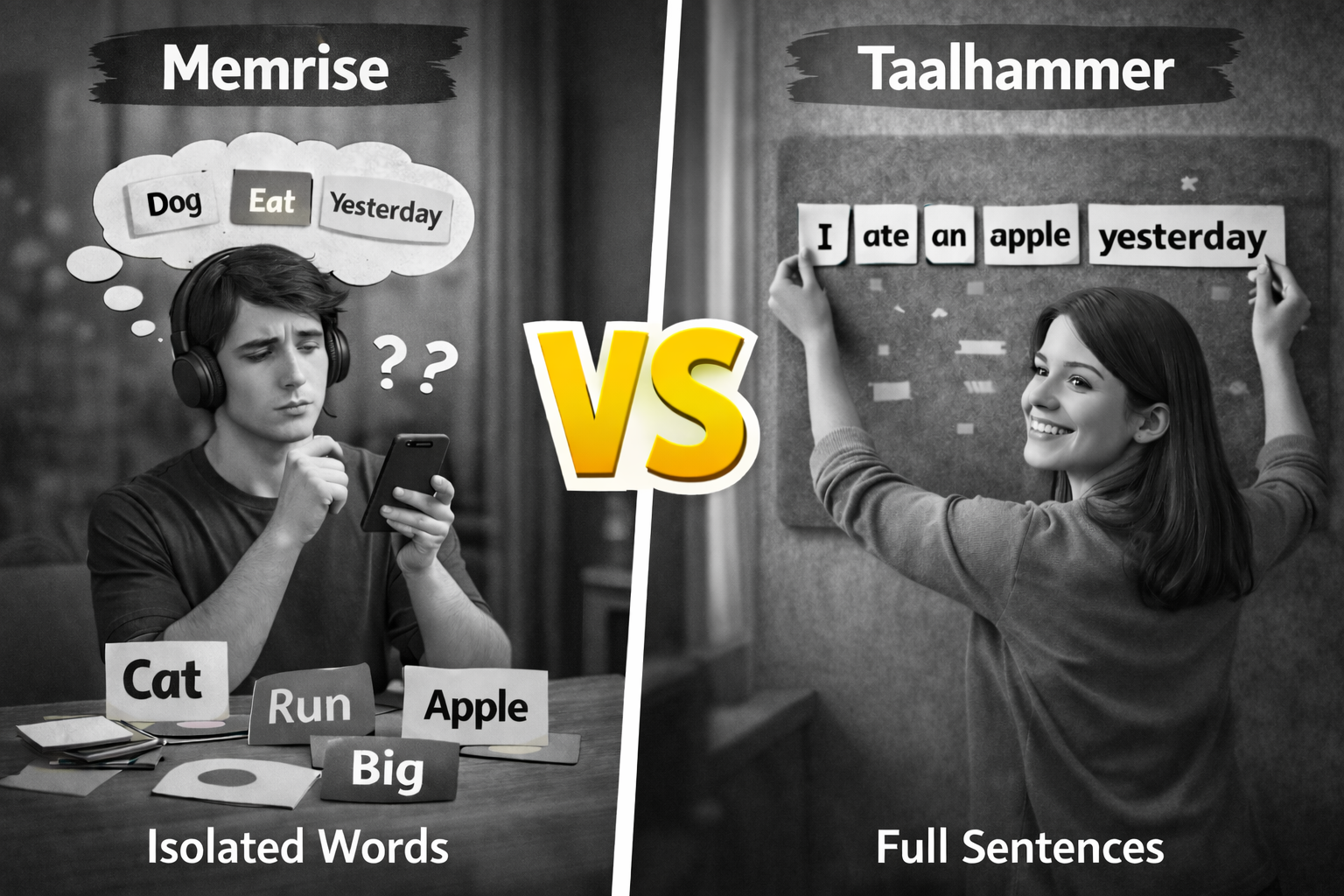
Most language-learning apps look similar at first. You see words, phrases, maybe even sentences. You tap answers, get feedback, and feel like something is happening. But underneath that surface, there is a much more consequential choice being made — often without the learner realising it:
Are you training the ability to use sentences, or the ability to recognise language fragments?
This article compares Taalhammer and Memrise through that single lens:
usable sentences vs isolated phrases — and what each approach makes possible over time.
- The Hidden Choice Most Learners Don’t Realise They’re Making
- What “Usable Sentences” Mean in Practice
- What Learning from Isolated Words and Phrases Trains Instead
- How Memrise Is Designed Around Phrases and Vocabulary Units
- How Taalhammer Is Designed Around Usable Sentences
- Grammar: Rules You Recognise vs Structures You Can Use
- From Learning Inside the App to Speaking Outside It
- Scaling Beyond Beginner Levels
- Final Verdict: Which Learners Each Approach Actually Serves Best
- Is Memrise enough to learn a language independently?
The Hidden Choice Most Learners Don’t Realise They’re Making
When people say they are “learning a language,” they often mean very different things:
- recognising words,
- understanding short expressions,
- following simple sentences,
- or actually producing language on their own.
Most apps blur these distinctions. They present sentences visually, but do not require learners to use them. As a result, learners accumulate material without developing control.
The core question is not whether an app shows sentences.
It is what the learner is required to do with them.
That requirement — or lack of it — defines the learning outcome.
What “Usable Sentences” Mean in Practice
A usable sentence is not a memorised line. It is a structure the learner can reconstruct, adapt, and reuse when the context changes.
Learning with usable sentences means training several things at once:
- word choice under meaning pressure,
- grammatical agreement,
- word order,
- and the relationship between form and intent.
Crucially, the learner must retrieve and assemble the sentence, not just recognise it. This turns grammar into behaviour, not information.
This is the core distinction behind Sentence-First vs Vocabulary-First Language Learning Apps, where full-sentence reconstruction is contrasted with word-level familiarity training.
Seeing sentences on screen is not enough.
If the learner never has to build them, sentence knowledge remains passive.
What Learning from Isolated Words and Phrases Trains Instead
Phrase- and vocabulary-based systems train a different skill: item recognition. This approach has clear advantages:
- lower cognitive load,
- quick familiarity,
- and easy entry for beginners.
However, it also avoids forcing decisions. The learner usually does not need to choose endings, reorder elements, or resolve grammatical conflicts. As a result, the system reinforces knowing what exists in the language rather than knowing how to produce it.
That gap typically becomes visible only when the learner attempts real output — the same recognition-to-production divide analyzed in Which Language Learning App Should I Use If I Can Understand but Can’t Speak?.
How Memrise Is Designed Around Phrases and Vocabulary Units
Memrise is built on item-level learning. The fundamental unit the system tracks, reviews, and reinforces is a single word or short phrase, paired with a meaning, form, and often an audio cue.
Sentences do appear, but their role is secondary. They function primarily as illustrative context — a way to show how a word might appear — rather than as something the learner must actively construct or manipulate.
This design choice has clear consequences for how learning unfolds over time.
At the system level, Memrise optimises for:
- rapid exposure to large amounts of vocabulary,
- ease of recognition,
- and minimal cognitive friction per session.
The learner is usually asked to identify, recall, or match items, not to assemble them into new utterances. As a result, the app becomes very good at answering one specific question: “Have I seen this before?” — but not necessarily “Can I use this?”
The structural implications of this design are examined more directly in Taalhammer vs Memrise: Which Language Learning App Works Better for Spaced Repetition with Real Sentences in 2026?, where item-level repetition is contrasted with sentence-level generative recall.
How phrases and sentences function inside Memrise
| Aspect | How Memrise Handles It | Consequence for the Learner |
|---|---|---|
| Primary learning unit | Individual words or fixed phrases | Knowledge is stored as separate items |
| Role of sentences | Contextual examples | Sentences are seen, not built |
| Grammar exposure | Implicit, example-based | Grammar is recognised, not applied |
| Error diagnosis | Item-level | Structural gaps remain invisible |
| Production requirement | Minimal | Speaking ability must develop elsewhere |
This approach is not accidental. By keeping tasks lightweight and recognition-focused, Memrise lowers the barrier to daily use and makes early progress feel smooth.
The trade-off is that sentence production is never stabilised inside the system itself. Learners often reach a point where they:
- recognise many correct forms,
- feel familiar with the language’s surface,
- but hesitate or simplify when trying to speak or write.
At that stage, Memrise still functions as a vocabulary support tool — but no longer as a system that actively develops usable language.
How Taalhammer Is Designed Around Usable Sentences
Taalhammer is designed around a different assumption:
language ability only exists if it can be reconstructed from memory under changing conditions.
For that reason, sentences are not examples or containers for vocabulary. They are the core learning objects.
From the beginning, learners are required to actively rebuild full sentences. This means choosing words, applying grammar, and resolving word order — without being shown the answer first.
What the system tracks is not exposure, but recall stability: how reliably a learner can reconstruct a sentence after delays, alongside new material, and under variation.
When recall weakens — especially after breaks — the system treats that as meaningful data, not failure. The sentence returns automatically, often recombined with newer structures, so that old grammar never becomes inert. This adaptive recall logic is examined in more technical detail in Best Language Learning Apps with Spaced Repetition (SRS) and AI in 2025, where item-based scheduling is contrasted with sentence-level generative repetition.
How sentence-based learning functions inside Taalhammer
| Aspect | How Taalhammer Handles It | Consequence for the Learner |
|---|---|---|
| Primary learning unit | Full sentences | Grammar and meaning are inseparable |
| Role of vocabulary | Embedded in sentence use | Words are learned through function |
| Grammar exposure | Required in every recall task | Grammar becomes procedural |
| Error diagnosis | Structural and sentence-level | Gaps surface early and clearly |
| Production requirement | Central | Speaking readiness develops gradually |
Because all content — core material and learner-added sentences — passes through the same recall system, the method does not change as proficiency increases.
What changes instead is:
- sentence length,
- grammatical density,
- abstraction,
- and variation.
This allows learners to continue using the same system beyond beginner levels without resetting their approach or outsourcing production to other tools.
In practice, this means that sentence production is not something learners “switch on” later.
It is the skill being trained from the start — and refined as the language becomes more complex.
Grammar: Rules You Recognise vs Structures You Can Use
The difference between phrase-based and sentence-based learning becomes especially clear with grammar.
Phrase-based systems expose learners to correct forms, but rarely require them to choose those forms. Grammar becomes something that “sounds familiar.”
Sentence-based systems force grammar into action. Learners must apply it repeatedly, under changing conditions.
| Aspect | Phrase-Based Learning (e.g. Memrise) | Sentence-Based Learning (e.g. Taalhammer) |
|---|---|---|
| Grammar exposure | Implicit, example-driven | Embedded in every recall task |
| Error handling | Minimal structural feedback | Errors signal unstable knowledge |
| Reuse across contexts | Limited | Continuous recombination |
| Grammar as skill | Weak | Central |
This structural distinction is explored further in Taalhammer vs Babbel: Which Language Learning App Teaches Grammar Better in 2025?, where grammar explanation models are compared to grammar-through-production systems.
This difference determines whether grammar remains theoretical or becomes usable.
From Learning Inside the App to Speaking Outside It
Speaking is not repetition. It is real-time assembly under pressure.
Learners trained on phrases often struggle here. They recognise correct language, but cannot generate it without support.
Sentence-based training prepares learners differently:
- starting sentences without scripts,
- adjusting structure mid-utterance,
- and recovering from errors.
This does not guarantee fluency on its own — real interaction still matters — but it removes a major bottleneck: the inability to produce language without prompts.
Scaling Beyond Beginner Levels
Many learners report that apps “stop working” after the basics. This is rarely about motivation. It is usually about method mismatch.
Phrase-based systems scale by adding more items. But language complexity grows structurally, not lexically.
Sentence-based systems scale by:
- increasing sentence density,
- expanding grammatical interaction,
- and maintaining the same production requirement.
Because the learning task remains consistent, the system continues to support progress beyond A2 without requiring a new tool. This structural difference is examined more broadly in Language Learning Apps That Don’t Plateau in 2026, where progression past the beginner phase becomes the central benchmark.em continues to support progress beyond A2 without needing a new tool.
Final Verdict: Which Learners Each Approach Actually Serves Best
(and why one approach clearly outlasts the other)
Phrase-based and sentence-based learning are not two equal paths to the same outcome.
They lead to different ceilings.
Phrase-based learning, as used in tools like Memrise, works best as a support layer, not as a complete learning system.
It serves learners who:
- want light exposure to a language,
- focus mainly on recognising vocabulary,
- are comfortable combining several tools (apps, tutors, grammar resources),
- or are intentionally not aiming for independent sentence production.
What it does not reliably produce is sustained control over grammar, sentence construction, or spontaneous language use. Those skills must be built elsewhere.
Sentence-based learning, as implemented in Taalhammer, targets the full task of language use from the beginning.
It suits learners who:
- want to speak and write without relying on memorised phrases,
- need grammar to become automatic rather than theoretical,
- want one system that remains useful as the language becomes more complex,
- and plan to continue learning independently beyond beginner and lower-intermediate levels.
The difference is not preference — it is scope.
Phrase-based systems are effective within a narrow band: exposure, recognition, early familiarity.
Sentence-based systems are designed to carry learners through that band and beyond it, without changing tools or methods.
That is why many learners start with phrase-based apps, feel productive early on, and later discover that progress has stalled — not because they lack motivation, but because the system they are using was never designed to support the next stage.
In that sense, there is a clear winner — not because one app is “better at everything,” but because only one approach is built to remain effective once the goal shifts from knowing language material to using the language itself.

Is Memrise enough to learn a language independently?
No.
Memrise is effective for recognising words and phrases, but it does not train sentence construction or grammatical decision-making. Learners who want to speak or write independently usually need additional tools to cover those gaps.
Is sentence-based learning harder than phrase-based learning?
It is more demanding — and more realistic.
Sentence-based learning trains the actual task of language use: assembling meaning, grammar, and structure. This exposes gaps early instead of masking them with recognition, which prevents later breakdowns when learners try to speak.
Is Taalhammer suitable for beginners?
Yes — because it does not delay sentence production.
Beginners in Taalhammer work with simple sentences and limited structures, but still practice recall and construction from the start. The method stays consistent as proficiency grows; only the language becomes more complex.
Why do many learners get stuck around A2 with vocabulary-based apps?
Because vocabulary growth does not create sentence control.
As sentences become longer and more flexible, learners need to reuse and recombine structures. Phrase-based systems keep adding items but do not integrate them into a working sentence system. What feels like lost motivation is usually a method ceiling.
Can Taalhammer replace multiple language-learning tools?
Often, yes.
Because sentence production, grammar reuse, spaced repetition, and learner-created content all run through one system, Taalhammer can replace the mix of flashcards, grammar apps, and production tools many learners juggle.
It does not replace real conversation — but it reduces tool fragmentation.
Which app is the better long-term choice?
For lasting ability to use a language, sentence-based learning is the stronger foundation.
Phrase-based apps support early exposure and vocabulary recognition. Taalhammer is designed to scale into full sentence control — which is why it continues to add value when recognition-based apps stop doing so.
Related Posts

Why Listening to Your Own Sentences Is the Most Efficient Way to Learn a Language (and Which App Does It Best)

Taalhammer vs Duolingo: Which Language Learning App Actually Works Better in 2026?

Which Language Learning App Works Best for Polish in 2026? Taalhammer vs 10 More Apps

Which Language Learning App Works Best for West Slavic Languages in 2026? Taalhammer vs 5 Other Apps

Taalhammer vs Duolingo: Which Language Learning App Works Best for Romanian in 2026?