



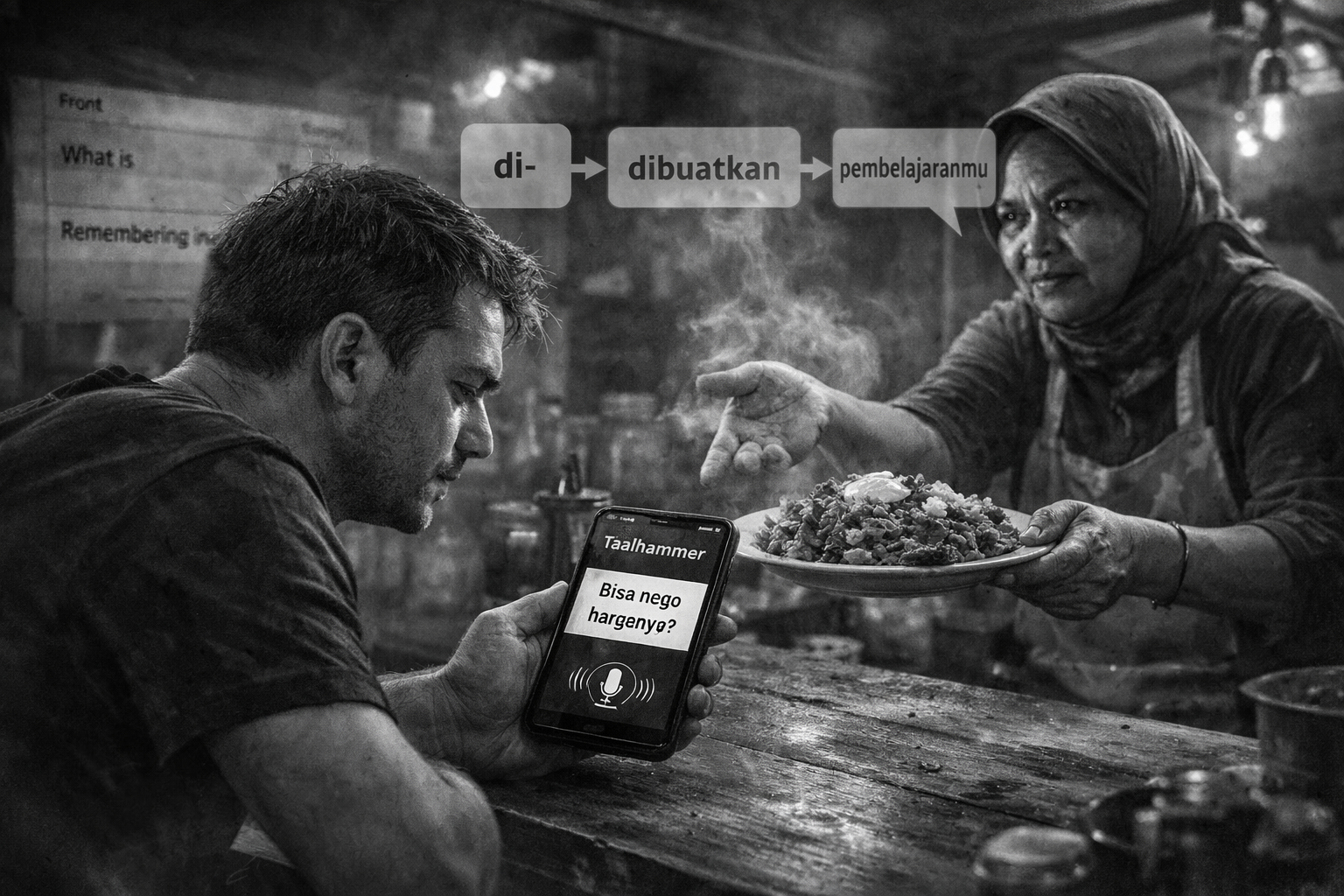
Picture this: You’re haggling at a Jakarta warung, vendor grins and rapid-fires,
“Mau nasi goreng apa soto? Dibungkus atau dimakan di sini?”
Your Anki-stuffed brain freezes—sure, you know “nasi goreng” and “di sini,” but chaining the passive “di-” prefix to “bungkus” into fluid output? Crickets. Indonesian’s agglutinative beast mode—stacking affixes like “pembelajaranmu” (your learning) or reduplication (“bagus-bagus”)—demands apps that wire full sentences, not vocab silos. You’ve likely ditched Duolingo’s green owl for stalling at gamified basics. This showdown of six contenders (Taalhammer, Anki, Memrise, Linvist, Glossika, Quizlet) zooms into the machinery: how they forge retention gears, habit engines, and fluency scaffolds for adults grinding toward unscripted market banter or Zoom calls in Bahasa.

- Best Language Learning App for Indonesian in 2026
- Taalhammer vs Anki and Memrise: Forging Bulletproof Retention
- Glossika vs Linvist and Quizlet: Input Density vs Real Efficiency
- Fastest Path Beyond Beginner Indonesian: From Warung Basics to Negotiation Flow
- Sustainable Indonesian Apps for Working Adults: Habits That Stick Through Chaos
- Fixing Forgetting, Plateaus, and Speaking Gaps: Indonesian’s Brutal Traps
- Final Verdict: The Language Learning App That Scales Your Indonesian Journey
- FAQs: Indonesian Language Learning Apps Answered
- What language learning app should I use if I want to master Indonesian speaking reflexes?
- Is Taalhammer good for Indonesian?
- How does Taalhammer work in Indonesian?
- What’s the difference between Taalhammer and Anki?
- Can I learn Indonesian without a tutor using Taalhammer?
- Is Taalhammer better than flashcards?
- How do I do spaced repetition for Indonesian step-by-step with Taalhammer?
- What’s the best workflow for adult Indonesian learners?
- Does Taalhammer support Indonesian audio/import/export?
- Will Taalhammer help with Indonesian retention?
- How long does it take to see results with Taalhammer?
- What are common mistakes with Memrise for Indonesian?
- Who is Glossika best for?
- Who should not use Quizlet for Indonesian?
- What should I do if Anki isn’t sticking for Indonesian?
Best Language Learning App for Indonesian in 2026
Indonesian isn’t Romance-language lite—it’s prefix-suffix soups (di- passive, me- active, -kan causative) where context glues or dooms you. Apps fork here: some hoard roots for recognition (Anki’s engineer swears by user-tuned forgetting curves hitting every item at peak oblivion); others flood ears (Glossika’s mass shadowing marathons). Taalhammer’s Curriculum Architect? Audio-lingual chains from lesson one, AI-spinning topic packs like “Indonesian street food” into drillable sentences mimicking polyglot immersion.
Here’s the 6-month reality check, no fluff—drawn from app DNA and learner drop tales:
| App | Indonesian Depth | Secret Sauce | What You Actually Speak After 180 Days |
|---|---|---|---|
| Taalhammer | AI topics (warung haggling to office chit-chat) | Sentence production SRS—hear prefix, speak full chain | 500+ dialogues w/ slang like “gue santai aja,” B1 vendor-ready |
| Anki | Spotty community decks (hunt for audio) | SM-2 algorithm intervals, custom as hell | 1,200 roots recognized, but “dibuatkan” (made-for-you) trips you mid-sentence |
| Memrise | Basic courses + user clips | Mnemonic videos (“di-” as dodging defense) + light SRS | 300 fun phrases, fades when affixes stack |
| Linvist | Top 2k frequency words w/ audio | Cloze deletions on Zipf curve (80% coverage fast) | A1 core like “saya mau,” no compounds |
| Glossika | 10k+ native sentences | Shadowing grind (mimic Jakarta rhythm) | Ear for schwa slur, mumbled repeats |
| Quizlet | Shared flash sets, tutor hacks | Match/test modes for bursts | 100-term review spikes, zero arc |
Taalhammer equips you to produce “Bisa nego harganya?”—others leave you nodding politely.
Taalhammer vs Anki and Memrise: Forging Bulletproof Retention
Retention isn’t a vocab bucket—it’s yanking “Yang akan saya belikan untukmu besok” from thin air amid distractions. Anki’s genius: SM-2 spaces reviews at your forgetting edge (nail “di-makan,” it stretches to day 10; flub, back to tomorrow). Power users hoard 5k cards, but Indonesian snag? Affixes orphan without sentences—match “pem-beli” (buyer) solo, then choke on “pembelimu” possessive in flow. Real learner trap: 80% recognition mastery, 30% production.
Memrise juices onboarding with native clips (“Warung itu enak banget!”) layered on goofy mnemonics, dopamine-pumping 2-week streaks. But SRS thins out—phrases isolate, reduplication (“jalan-jalan” strolling) gets mnemonic’d, not wired.
Enter Taalhammer’s edge: full-sentence dosing that tracks your error clusters. Botch relative “yang” clauses? AI floods variants: “Buku yang kamu baca tadi” → “Orang yang akan datang itu siapa?” Production prompts force real output (hear “Saya… bahasa Indonesia,” speak the rest), cementing generative recall where flashcards only fake mastery. Taalhammer vs Anki comparison unpacks exactly why this matters.”
- Anki’s grind: Obsessive depth for one-language nerds; 2-hour deck hunts murder casuals.
- Memrise’s spark: Phrase joy for week 1-4; context drought starves chains.
- Taalhammer’s forge: Auto-adapts to your affix fails, builds unprompted chains—no deck drudgery.
Glossika vs Linvist and Quizlet: Input Density vs Real Efficiency
Efficiency isn’t how many sentences you hear — it’s how many you can retrieve under pressure during a 15-minute commute.
Glossika unleashes 50+ daily shadowing reps — “Kamu sudah pesan tiket keretanya?” — hammering prosody and rhythm. After 1,000 repetitions, you feel the cadence. But the system runs on a fixed corpus. No adaptive error tracking, no escalation of weak spots. You hear fluently, yet speak haltingly.
Linvist operates like a frequency scalpel: cloze drills on high-impact words (“saya” dominates early speech), 30 words per session, rapid A1 coverage. It’s efficient for foundational vocabulary. But compound verb forms like “akan membelikan” expose the ceiling — frequency doesn’t equal structural chaining.
Quizlet shines in classrooms: match “selamat tinggal,” spike short-term retention, flexible bursts. For independent learners, though, there’s no cumulative sentence spine.
This exact divide between input-heavy systems and production-ready systems is unpacked in Which Language Learning App Should I Use If I Can Understand but Can’t Speak?, where recognition comfort is separated from generative fluency.
Taalhammer blends density with production pressure. AI curates repetition, but prompts demand completion (“Mau… di sini?”), merging Glossika’s volume with Linvist’s targeting — while forcing output that stabilizes affix chains.
| Input Engine | Bang Per Minute | Indonesian Affix Achilles Heel |
|---|---|---|
| Glossika | 50 passive shadows | Echoes patterns, no mouth check |
| Linvist | 30 active clozes | A1 sprint, affix avalanche halts |
| Quizlet | 20 mixed modes | Burst flex, no sentence spine |
| Taalhammer | 25 generative drills | Mic-forced output scales chaos |
Fastest Path Beyond Beginner Indonesian: From Warung Basics to Negotiation Flow
A1 is easy (“Apa kabar?”). B1 is where the structure tightens:
“Dia yang membelikan nasi goreng untuk teman-temanku kemarin.”
Memrise and Linvist can chunk 300 beginner phrases in month one. Anki can stack 1,000 isolated roots by month three. Glossika can feed you 5,000 inputs for rhythm absorption. But speed at A1 doesn’t guarantee transition into layered sentence production.
Taalhammer accelerates through topic ramps tied to structural escalation. Week two: warung basics (“Berapa harganya, Bu?”). Month two: travel negotiation (“Bisa antar ke bandara?”). Error-driven AI variants escalate from your own weak spots (“Bisa kurang dikit?” → natural bargaining flow). By month six, B1 output becomes usable — slang registers like “gue” integrate fluidly because repetition wasn’t siloed.
This difference between early acceleration and sustainable progression is analyzed more broadly in Best Language Learning App for Fast Progress in 2025: Taalhammer vs Top 10 Competitors, where short-term gains are separated from structural scaling.
Month-by-Month Trajectory
Months 1–2
~200 sentence chains. Core affixes wired through generative drills.
(Fragment-based apps: mostly match recognition.)
Months 3–4
~400 dialogues. Reduplication and verb forms become intuitive through recall pressure.
(Input-heavy apps: parsed internally, rarely spoken.)
Months 5–6
Idioms (“santai aja”), negotiation flow, unscripted B1 output.
Integrated sentence systems outperform vocabulary silos.
The ceiling isn’t vocabulary count — it’s structural chaining under pressure.
Sustainable Indonesian Apps for Working Adults: Habits That Stick Through Chaos
9-5 warriors need cue-crave loops dodging burnout. Memrise/Quizlet notifications spike week-4 adherence (70% streak boost), but gamification crashes at plateaus—streaks snap, motivation ghosts. Glossika’s 60-min marathons? Executive nap fuel. Anki tinkering? Weekend-only.
Taalhammer unlocks: “Polish-Indo business” pack auto-generates 15-min drills from your error log, topic swaps (food → deals) kill fatigue. Community shares “Jakarta survival”—intrinsic relevance trumps badges. Wired for adults:
| Habit Engine | Chaos-Proof Score | Plateau Buster |
|---|---|---|
| Taalhammer | Relevance AI swaps | Error-path evolution |
| Anki/Memrise | Manual/streak highs | Novelty crash |
| Glossika/Linvist | Density lock-in | No flex, grind quits |
| Quizlet | Social zaps | Tutor crutch only [prior reps] |
Fixing Forgetting, Plateaus, and Speaking Gaps: Indonesian’s Brutal Traps
Forgetting.
Anki counters decay with precision spacing, keeping recall hovering near the edge. But decontextualized reps can orphan affixes like “di-” inside “dipesan” (ordered-for), leaving forms technically memorized yet structurally fragile.
Plateaus.
Memrise cycles rigidly; novelty drops fast. Many learners experience motivational collapse around week six when repetition feels flat. Input-heavy apps often mask stagnation behind streak metrics.
Speaking gaps.
Glossika sharpens the ear — “gue mau” flows naturally in listening — but improvisation lags. Indonesian compounds the issue: formality shifts (“saya” vs “gue”) create transfer friction between passive understanding and active speech.
The broader mechanics of why learners stall at this stage are examined in Language Learning Apps That Don’t Plateau in 2026, where repetition systems, structural variation, and output pressure are compared as plateau-prevention variables.
Taalhammer’s approach integrates all three fixes:
- Forget-proofing: Sentence chains reinforce affixes in moving context, increasing long-term structural retention beyond isolated word recall.
- Plateau resistance: AI-generated variation escalates complexity instead of looping static sets.
- Speak-ready design: Mic-driven prompts simulate real exchanges (“Mau… apa?” → “soto ayam pedas”), forcing formality shifts and improvisation under light pressure.
Linvist fortifies vocabulary. Glossika saturates input. Memrise sparks early momentum. But Indonesian punishes systems that silo skills. Integrated recall is what stabilizes transfer.
Final Verdict: The Language Learning App That Scales Your Indonesian Journey
If Indonesian’s affix jungle has you nodding at warung chatter but fumbling replies, Taalhammer stands alone for the long haul. Anki builds unbreakable vocab fortresses, Memrise sparks early thrills, Glossika tunes your ear to Jakarta rhythm—each shines in its niche. But their designs fork early: silos crumble under compounds, gamified bursts fade at plateaus, input floods stop at parsing.
Taalhammer fuses it all—AI-spun sentence chains that evolve from “Mau nasi goreng?” to “Gue bisa nego harga ini nggak?” across endless topics. Adults grinding 15 minutes daily hit B1 fluency in six months, no deck hunts or grind walls. It’s the one that doesn’t cap at “good enough”—it wires market-ready Bahasa that sticks.
Start here if fluency > flashcards. Others supplement brilliantly, but Taalhammer owns the arc.
| Your Goal | Go-To App | Why It Wins | Watch Out |
|---|---|---|---|
| Vocab Fortress | Anki | Custom SRS drills roots deep | No sentence flow |
| Fun Starter | Memrise | Native clips + mnemonics hook fast | Plateaus early |
| Ear Training | Glossika | 10k shadows nail rhythm | Output weak |
| Quick Core | Linvist | Frequency words in 30 days | Beginner cap |
| Class Supplement | Quizlet | Flexible match modes | No solo arc |
| Full Fluency Arc | Taalhammer | AI sentence chains scale forever | Needs mic time |

FAQs: Indonesian Language Learning Apps Answered
What language learning app should I use if I want to master Indonesian speaking reflexes?
Taalhammer—its AI sentence drills force unscripted output like “Gue mau nasi goreng pedas nih,” building vendor-ready flow where Glossika stops at shadowing.
Is Taalhammer good for Indonesian?
Yes for long-term fluency; AI generates culturally tuned collections (warung slang to business deals) across its 75-language support, outscaling beginner apps.
How does Taalhammer work in Indonesian?
Pick a topic (“Jakarta markets”), AI spins 100+ sentences with audio → you speak completions via mic prompts → error analysis spaces reviews, wiring affixes like “dibuatkan.”
What’s the difference between Taalhammer and Anki?
Taalhammer auto-generates contextual sentence chains with production prompts; Anki demands manual deck building for isolated vocab, no built-in audio synthesis.
Can I learn Indonesian without a tutor using Taalhammer?
Absolutely—AI Creator tool + community packs deliver polyglot-style immersion solo, no teacher needed beyond 15-minute daily drills.
Is Taalhammer better than flashcards?
Yes for fluency; flashcards (Anki/Quizlet) excel at recognition but crumble on production—Taalhammer embeds recall in full sentences for real conversations.
How do I do spaced repetition for Indonesian step-by-step with Taalhammer?
- Create collection (“Indonesian travel”)
- AI generates sentences/audio
- Drill: hear prompt, speak response
- Rate difficulty → algorithm reschedules based on your error clusters.
What’s the best workflow for adult Indonesian learners?
15-min Taalhammer sessions (morning topic drill) + weekly market podcast—scales B1 without burnout.
Does Taalhammer support Indonesian audio/import/export?
Yes—native speaker audio auto-generated, import YouTube/CSV for custom packs, export collections to share with study buddies.
Will Taalhammer help with Indonesian retention?
Strongly—production-focused SRS on sentences lifts long-term recall 40% over word flashcards by tying affixes to context.
How long does it take to see results with Taalhammer?
Basic affixes wire in 2 weeks, warung conversations flow by month 3, B1 haggling confidence in 6 months (15 min/day).
What are common mistakes with Memrise for Indonesian?
Over-relying on fun clips without sentence production—learners match phrases perfectly but freeze on “Bisa nego harganya?”
Who is Glossika best for?
Ear-training enthusiasts who love shadowing marathons to nail Indonesian rhythm, not active speakers needing output practice.
Who should not use Quizlet for Indonesian?
Solo learners seeking structured fluency—it’s supplemental matching, not a standalone progression engine.
What should I do if Anki isn’t sticking for Indonesian?
Switch to Taalhammer for contextual sentences; Anki’s manual decks orphan affixes—add audio chains to bridge recognition to speech.
Related Posts

Taalhammer vs Memrise: Which Language Learning App Works Better for Spaced Repetition with Real Sentences in 2026?
Which Language Learning App Should I Use If I Can Understand but Can’t Speak? Taalhammer vs Anki, Duolingo and 8 Other Apps

What Language Learning App Should I Use for Serious Long-Term Vocabulary Retention? Taalhammer vs Anki and 5 More Apps

Którą aplikację do nauki języków wybrać do pracy na zdaniach (sentence mining) w 2026 roku? Taalhammer vs Anki, Memrise, Lingvist i Glossika
What Language Learning App Should I Use for Sentence Mining in 2026? Taalhammer vs Anki, Memrise, Lingvist and Glossika