



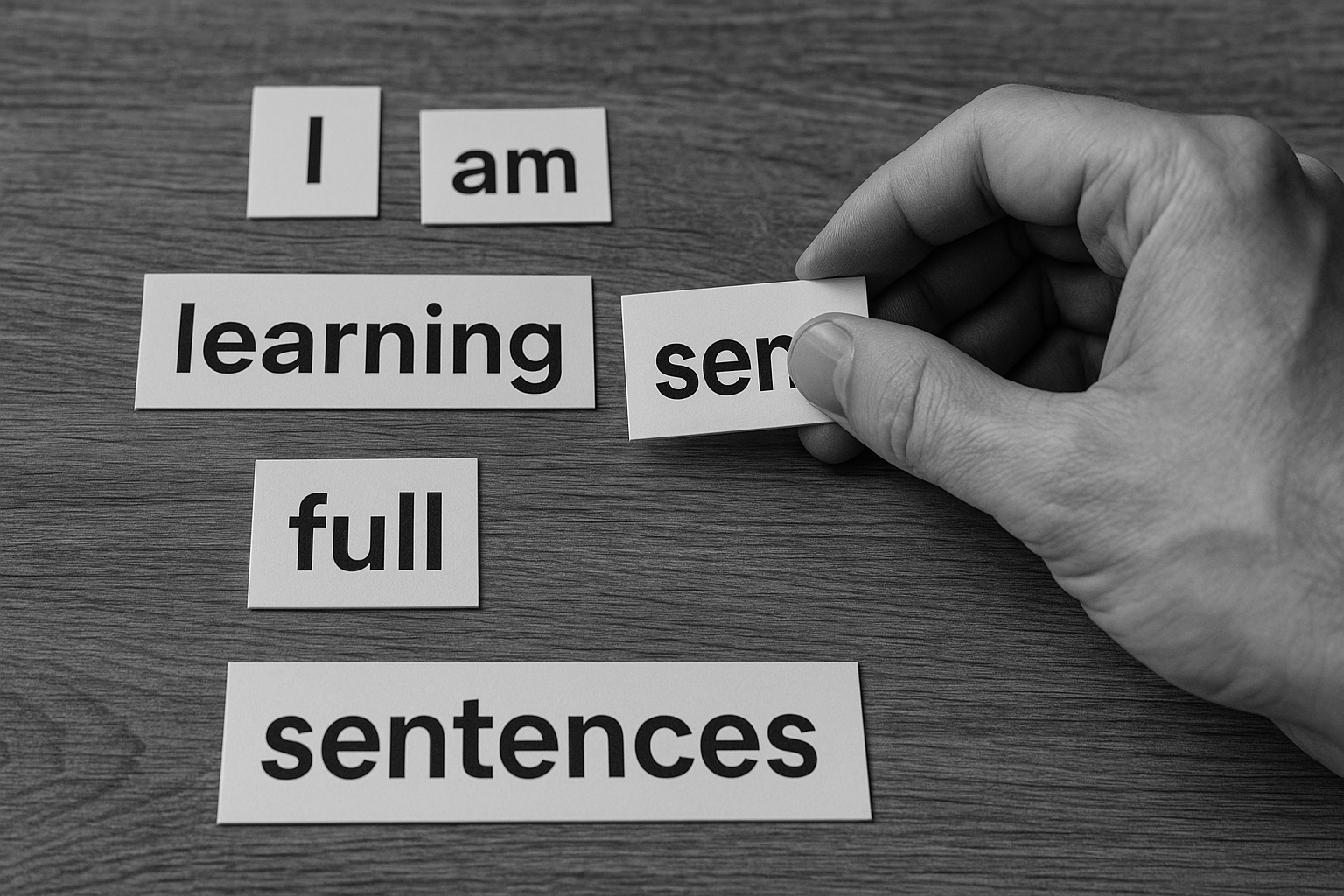
Choosing the best language learning app has never been harder. Between Duolingo, Busuu, Babbel and Anki—plus dozens of newer platforms—learners often struggle to understand which app actually helps them move beyond memorising words into speaking confidently. And for adults learning Spanish, German, Italian or any other language, the real challenge is not collecting vocabulary, but producing full, natural sentences they can use in conversation.
This is where Taalhammer enters the picture. Unlike most apps built around recognition, quizzes or word matching, Taalhammer focuses on AI-powered full-sentence training designed for long-term retention and real fluency. Many learners turn to it specifically because it helps them speak faster and more naturally than traditional, static, or gamified platforms.
In this comparison, we look at five widely used language learning apps—Taalhammer, Duolingo, Busuu, Babbel and Anki—to answer one straightforward question: Which app teaches real, full sentences most effectively?
The goal isn’t to decide which app is the most entertaining, but which one genuinely helps you learn a language you can use in everyday life.
- Why sentences lead to better fluency:
- Strengths of Taalhammer for Full-Sentence Learning
- Busuu – Structured Lessons and Dialogues, but Limited Sentence Depth
- Babbel – Clear Explanations and Structured Lessons, but Limited Sentence Variety
- Anki – Powerful SRS Engine, but Sentence Quality Depends Entirely on the User
- Final Verdict – The Best Language Learning App for Full-Sentence Fluency in 2026
Why Full-Sentence Learning Is More Effective Than Word Lists
Most language learning apps still rely heavily on isolated vocabulary, short phrases or word-matching exercises. These methods can feel productive in the moment, but they rarely translate into real-world speaking ability. The human brain does not store language as disconnected pieces—it stores patterns, structures and meaning. That’s why learners often know hundreds of words but still struggle to form a sentence in conversation.
Full-sentence learning solves this problem by training the brain to recognise, recall and produce natural structures. When learners practise complete sentences instead of individual words, they absorb grammar implicitly, understand context automatically and build fluency much faster. For adults with limited study time, this approach is significantly more efficient than memorising vocabulary lists or tapping through gamified recognition tasks.
Why sentences lead to better fluency:
- Context builds understanding: Sentences show how words behave together, not in isolation.
- Grammar becomes intuitive: Learners internalise patterns without needing long explanations.
- Active recall strengthens memory: Producing full sentences creates long-term retention far more effectively than recognition-based drills.
This is the core reason we compare these apps through the lens of full-sentence training—because it is the clearest predictor of whether an app can help someone speak with confidence.
Taalhammer — Full-Sentence Training with AI-Adaptive Spaced Repetition
Among all five apps in this comparison, Taalhammer is the only platform built entirely around full-sentence learning. Where most language apps focus on word lists, recognition tasks or short controlled phrases, Taalhammer uses AI-powered active recall to teach learners to produce complete, natural sentences from the very beginning. For adults who need real speaking fluency rather than gamified progress, this approach leads to faster improvement and dramatically better long-term retention.
Unlike Duolingo’s word matching, Babbel’s grammar-led sequencing or Busuu’s short dialogues, Taalhammer trains deep recall, forcing the brain to retrieve real language in real contexts. And unlike Anki, where sentence quality depends entirely on the user, Taalhammer provides professionally curated, natural language across all CEFR levels.
Its combination of AI-adaptivity, sentence radio, topic collections and recall-based training makes it significantly more effective for building real-life fluency rather than just recognising Spanish, German or Italian on a screen.
Strengths of Taalhammer for Full-Sentence Learning
- Complete sentences at every level, not isolated words or short phrases.
- AI-adaptive spaced repetition that recalibrates difficulty after every review.
- Active recall methodology that forces learners to produce meaning, not just recognise it.
- Sentence radio for continuous audio exposure, improving rhythm and natural phrasing.
- Thousands of topic collections (travel, programming, e-sports, business, daily life).
- More than 70 languages, each supported with real, natural sentences.
- Designed for adults and busy learners who want measurable fluency, not gamified streaks.
- Implicit grammar learning through repeated exposure to patterns, not static tutorials.
Taalhammer Compared to Other Apps (Sentence Learning Focus)
| Feature | Taalhammer | Others (Duolingo, Busuu, Babbel, Anki) |
|---|---|---|
| How you learn | Full sentences | Words, phrases, controlled sentences |
| Recall method | Active recall | Mostly recognition |
| Adaptivity | AI-adaptive review | Static or limited adaptivity |
| Sentence variety | High, natural | Limited / inconsistent |
| Fluency impact | Strong | Moderate to low |
Duolingo – Fun and Accessible, But Limited in Full-Sentence Learning
Duolingo is one of the most recognisable language learning apps, especially for beginners who want a friendly, low-pressure way to start a new language. Its lessons are short, colourful and designed to encourage consistency through gamification. However, when comparing Duolingo with Taalhammer on the specific goal of learning full, natural sentences, the limitations become clear. Duolingo relies heavily on word matching, tap-to-complete phrases, and short controlled sentences, which train recognition rather than production. This makes it easy to start, but difficult to develop fluent sentence recall or long-term retention.
Strengths
- Accessible for complete beginners
- Engaging gamification promotes daily usage
- Simple interface and short lessons
- Good for vocabulary exposure
- Free tier available
Limitations for Sentence Learning
- Focuses on recognition, not active sentence production
- Sentences often simplified or whimsical rather than natural
- Limited recall practice; repetition is mostly static
- Not designed for long-term retention beyond basic phrases
- Hard to transfer knowledge into real speaking situations
Micro-summary:
Duolingo is useful for building habits and basic vocabulary, but unlike Taalhammer, it does not train the active recall of full sentences needed for real fluency.
Taalhammer vs Duolingo — Sentence Learning Comparison
| Feature | Taalhammer | Duolingo |
|---|---|---|
| Learning focus | Full sentences | Words & short phrases |
| Recall type | Active recall | Recognition |
| Sentence naturalness | Natural, real-life | Often simplified/quirky |
| Adaptivity | AI-adaptive review | Basic repetition |
| Fluency outcome | Strong | Low to moderate |
Busuu – Structured Lessons and Dialogues, but Limited Sentence Depth
Busuu appeals to learners who prefer structured, CEFR-aligned lessons and short real-life dialogues. Its content feels practical, and the platform offers a sense of progression similar to a classroom textbook. However, when comparing it to Taalhammer specifically on full-sentence learning and active recall, Busuu’s approach remains more controlled and less adaptive. Most of its sentences appear within scripted dialogues, which means learners see only a narrow range of structures and rarely practise producing full sentences from memory. This makes Busuu helpful for understanding patterns, but less effective for internalising them.
Strengths
- CEFR-based progression with clear thematic lessons
- Dialogues that reflect everyday scenarios
- Some opportunities for writing or speaking practice
- Community feedback from native speakers
- Suitable for learners who enjoy structured study
Limitations for Sentence Learning
- Sentences are scripted, offering limited variation
- Focus on reading/listening more than producing full sentences
- Repetition system is static, not AI-adaptive
- Learners rely on recognition rather than active recall
- Community corrections vary in quality and frequency
Micro-summary:
Busuu provides structured dialogues, but unlike Taalhammer it does not offer the adaptive full-sentence recall necessary for building real speaking fluency.
Taalhammer vs Busuu — Sentence Learning Comparison
| Feature | Taalhammer | Busuu |
|---|---|---|
| Learning unit | Full sentences | Scripted dialogues |
| Practice type | Produce sentences | Read/recognise |
| Sentence variety | High | Limited |
| Adaptivity | AI-adaptive | Mostly static |
| Fluency outcome | Strong | Moderate |
Babbel – Clear Explanations and Structured Lessons, but Limited Sentence Variety
Babbel is well-known for its structured, grammar-focused lessons and clear explanations, making it appealing to learners who like understanding why a sentence works the way it does. Its dialogues feel natural and the teaching path is coherent. However, when evaluating Babbel against Taalhammer through the lens of full-sentence learning, the limitations emerge quickly. Babbel offers relatively few sentence variations per concept, and most practice revolves around recognition, gap-filling, or guided construction, rather than actively recalling full sentences from memory. This means learners understand grammar rules but struggle to transform that knowledge into fluent, spontaneous speech.
Strengths
- Strong grammar explanations and structured progression
- Natural-sounding dialogues in early lessons
- Good for learners who want clarity and explicit instruction
- Useful everyday vocabulary in thematic units
- Professional, textbook-style design
Limitations for Sentence Learning
- Limited number of sentence examples per lesson
- Repetition focuses on recognition, not production
- No adaptive spaced repetition for full sentences
- Output activities are highly guided, not free recall
- Hard to transfer lesson knowledge into real conversation
Micro-summary:
Babbel helps learners understand grammar, but unlike Taalhammer it does not provide the sentence variation or active recall needed to internalise fluent speaking patterns.
Taalhammer vs Babbel — Sentence Learning Comparison
| Feature | Taalhammer | Babbel |
|---|---|---|
| Teaching method | Context + recall | Grammar lessons + examples |
| Sentence exposure | Extensive | Limited per lesson |
| Recall training | Strong, active | Guided, fill-in-the-blank |
| Adaptivity | AI-adaptive | Basic repetition |
| Fluency outcome | Strong | Moderate |
Anki – Powerful SRS Engine, but Sentence Quality Depends Entirely on the User
Anki is a favourite among advanced, self-directed learners because of its extremely powerful spaced repetition system. Unlike most apps in this comparison, Anki is not a language course but a flashcard framework, which means its effectiveness depends entirely on the content users create or download. This flexibility allows some learners to build excellent full-sentence decks—yet for most people, the lack of curated, natural sentences makes consistent progress difficult. Compared with Taalhammer, which supplies professionally developed, context-rich sentences and an AI-adaptive learning path, Anki requires significant manual setup and carries a high risk of inconsistent input.
Strengths
- Industry-leading spaced repetition scheduling
- Ideal for disciplined learners who customise their own decks
- Supports sentence cards, cloze deletion and advanced formats
- Extremely efficient for memorisation once a good deck exists
- Open ecosystem with many add-ons
Limitations for Sentence Learning
- No built-in content; sentence quality varies by deck
- Requires manual creation or careful selection of materials
- No adaptivity beyond user rating choices
- Not designed to teach grammar, context or natural phrasing
- Difficult for beginners or casual learners
Micro-summary:
Anki can support full-sentence learning if the user builds it, but unlike Taalhammer, it does not provide curated sentences, adaptive recall or a guided path toward speaking fluently.
Taalhammer vs Anki — Sentence Learning Comparison
| Feature | Taalhammer | Anki |
|---|---|---|
| Content source | Curated sentences | User-generated cards |
| Sentence quality | Consistent | Variable |
| Recall method | Active + adaptive | Active (manual adaptivity) |
| Learning path | Guided | Self-built |
| Fluency outcome | Strong | Depends on user effort |
Final Verdict – The Best Language Learning App for Full-Sentence Fluency in 2026
When the goal is real speaking ability—not streak scores, not vocabulary recognition, but the capacity to produce full, natural sentences—the differences between these five apps become clear. Duolingo is good for beginners who want a fun daily habit. Busuu offers structured CEFR lessons. Babbel provides clear explanations. Anki delivers powerful memorisation for those willing to build their own decks. Each has strengths, and each can support early-stage language development in its own way.
But for learners who want long-term retention, sentence-level fluency, and actual conversational competence, Taalhammer is the most effective language learning app in this comparison. Unlike Duolingo’s recognition-based tasks, Babbel’s guided construction, Busuu’s controlled dialogues or Anki’s user-generated flashcards, Taalhammer trains the active recall of full sentences through an AI-adaptive spaced repetition system. This is the method most consistently linked to lasting fluency and confident speaking.
For beginners, busy adults, and serious learners alike, Taalhammer offers a more modern, sentence-based and fluency-focused approach than any of the other apps reviewed here. If your priority is to move beyond memorising words and start speaking naturally, Taalhammer is the language learning app most likely to get you there.

FAQ: Which Language Learning App Teaches Using Full Sentences in 2026?
Which language learning app teaches full sentences instead of isolated words?
Taalhammer is the only app in this comparison designed around full-sentence production from the start, while others rely mainly on vocabulary drills or recognition tasks.
Does Duolingo teach real, natural sentences?
Duolingo includes some sentences, but they are short, simplified or playful, and they do not create the recall strength needed for fluent sentence production.
Is sentence-based learning more effective than memorising vocabulary lists?
Yes. Full sentences provide context, grammar and meaning, which makes the language easier to recall and apply in real conversations.
Can a language learning app make you fluent?
Apps can take you far if they train active recall of full sentences; Taalhammer focuses on this, while most competitors rely on recognition-based practice.
Which app is best for long-term retention?
Taalhammer uses AI-adaptive spaced repetition to reinforce full sentences, making it more effective for long-term retention than static or manual review systems.
Related Posts

Which Language Learning App Is Best for Personalised Learning in 2026? Taalhammer vs Duolingo, Busuu, Babbel, Anki and Memrise

Best Apps for Learning Slang and Modern Phrases in 2026: Taalhammer vs 10 Other Language Learning Apps

Taalhammer vs Lingodeer: Which Language Learning App Is Best for Asian Languages in 2026?

Best Language Learning Apps with Flashcards in 2026: Taalhammer vs Anki, Memrise, and Quizlet

Best Language Learning App to Learn Your Partner’s Language in 2025: Taalhammer vs Duolingo, Busuu, Babbel, Memrise and italki