



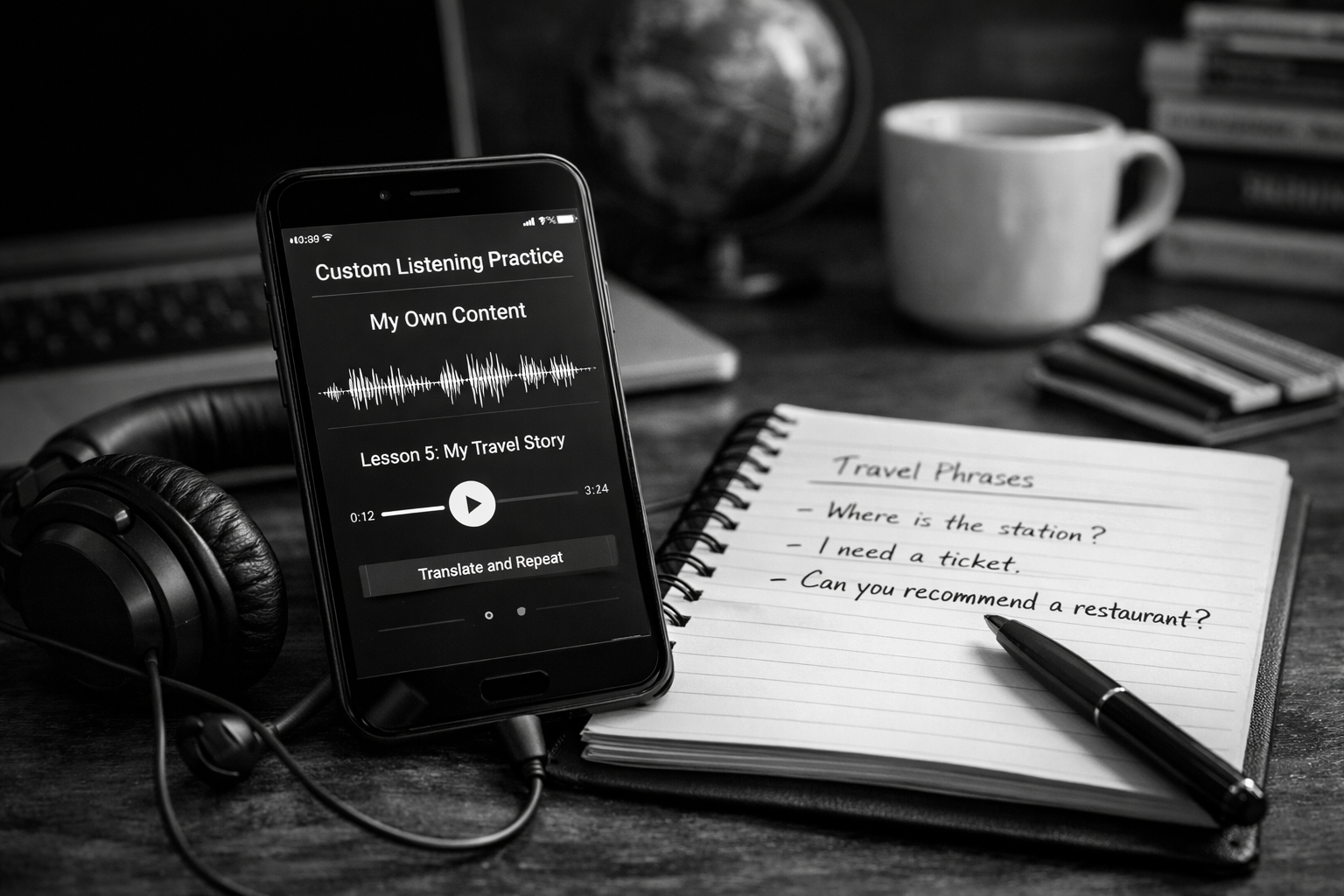
Almost every language learning app feels helpful at first. You make progress, recognize more words, understand more audio, and build a routine. Then, often without a clear moment of failure, something changes. You keep using the app, but your ability to actually use the language stops growing.
This isn’t a motivation problem. It’s a design problem.
The moment you move beyond canned lessons and want to learn from your own listening material—podcasts, videos, conversations, articles read aloud—you start to see which apps were built as learning systems, and which were built as introductions, tools, or supplements.
This article looks at 11 language learning apps through that lens:
Which ones can meaningfully support listening exercises using your own content, and which ones struggle once learning becomes personal, complex, and long-term.
- What Using “Your Own Content” Really Requires From a Language Learning App
- How Language Learning Apps Handle Listening — Fundamentally Different Models
- Why Listening Alone Doesn’t Transfer to Speaking (and Where Most Apps Break Down)
- Which App Models Help — and Which Ones You Eventually Outgrow
- Final Takeaway: Why Some Apps Are Tools — and One Is a Learning System
- FAQ: Best Language Learning App with Listening Exercises Using Your Own Content
- Can a language learning app really work with your own content?
- Why do many language learning apps stop helping after the basics?
- Why do I understand audio but still can’t speak?
- Is listening to native audio enough to become fluent?
- Why do learners often get stuck around A2?
- Do I need to switch apps as I improve?
- Is Taalhammer suitable for beginners?
- Can one app replace tutors or conversation platforms?
What Using “Your Own Content” Really Requires From a Language Learning App
On paper, “using your own content” sounds simple. Add audio. Import sentences. Maybe attach a translation. In practice, this creates three hard requirements that many apps never had to solve:
First, retention. Personal content doesn’t repeat itself naturally. A system must decide when and how that material returns, weeks or months later, without the learner manually tracking it.
Second, progression. Your own content doesn’t arrive neatly ordered from easy to hard. The app must be able to reuse and adapt it as your level changes, otherwise learning stalls.
Third, integration. Listening can’t sit in isolation. If audio doesn’t feed into recall, sentence production, and reuse, it stays comprehension-only.
Apps that rely on fixed courses, playlists, or one-off exposure tend to break at this point. Apps designed as systems tend to reveal their advantage here.
How Language Learning Apps Handle Listening — Fundamentally Different Models
When you compare apps by learning model rather than brand, the differences become clearer.
| System | Language learning app |
|---|---|
| System based listening + sentence production | Taalhammer |
| Course based listening | Duolingo, Babbel, Busuu |
| Audio – optional | Anki, Quizlet, Lingvist |
| Input and exposure | LingQ, Glossika, Memrise |
| Live listening with a tutor | italki |
System-Based Listening Integrated With Sentence Production
Taalhammer
In Taalhammer, listening is not treated as a separate skill or a passive activity. Audio—whether built-in or added by the learner—feeds directly into a sentence-based learning loop.
What matters here is not that you can add your own content, but what happens afterward. Sentences derived from personal audio are scheduled, recalled, recombined, and reused across time. They don’t remain tied to one context or one listening moment.
The system enforces active recall, not recognition. Listening leads to producing full sentences, often with variation. Grammar is absorbed through repeated use, not isolated explanation. Adaptive spaced repetition determines when items return, so personal content continues to work even as difficulty increases.
Because progression is not tied to a finite course, learners don’t reach a point where the system runs out. The same material evolves with them.
If you want to see how this system-based approach compares to other apps that allow user-generated material, this comparison of language learning apps for personalised learning breaks down where most tools fall short.
Course-Based Listening Inside Fixed Lessons
Duolingo, Babbel, Busuu
Course-based apps handle listening well within their own lessons. Audio supports comprehension, pronunciation awareness, and confidence at early stages.
The limitation appears when learners want to go beyond what the course provides. User-generated content plays a marginal role, if it’s supported at all. Retention is tied to lesson structure rather than memory decay, and once the course ends—or starts repeating itself—the system has little to say about what comes next.
These apps are effective introductions. They are not designed to manage open-ended, personal listening material over long periods.
Memorization Tools With Optional Audio
Anki, Quizlet, Lingvist
These tools excel at memory, not at learning design.
You can attach audio. You can store sentences. Retention, especially in Anki, can be extremely strong. But the system does not decide what to practice, how difficulty should evolve, or how listening should translate into production.
Effectiveness depends almost entirely on the learner’s ability to design a coherent method. For experienced learners, this can work very well. For most users, it results in fragmented knowledge: many remembered items, limited fluency.
Input-Heavy and Exposure-First Listening
LingQ, Glossika, Memrise
These apps emphasize large amounts of listening. Learners hear real language, often at scale. Comprehension improves, pronunciation becomes familiar, and anxiety drops.
What’s missing is enforced production. Listening is expected to turn into speaking naturally, through exposure alone. For some learners, this works to a degree. For many, comprehension races ahead while speaking lags behind.
The gap appears when learners can understand audio clearly but struggle to form sentences independently. Without recall and sentence construction, exposure remains incomplete.
For many learners, this is the point where passive understanding stops translating into confident speaking.
Tutor Platforms and Live Listening
italki
Live conversation with your friends or a partner offers real listening in real contexts. That’s its strength.
But italki is a platform, not a learning system. Retention, progression, and structure depend on the tutor and on what the learner does between sessions. Without a parallel system handling memory and reuse, progress is uneven and hard to sustain.
Conversation accelerates confidence. It does not, by itself, guarantee long-term development.
Why Listening Alone Doesn’t Transfer to Speaking (and Where Most Apps Break Down)
Understanding audio and producing language are not the same skill.
Most apps train recognition: selecting correct answers, following along, identifying meaning. Speaking requires recall: assembling structure and meaning without prompts.
This is why many learners report the same problems:
- “I understand everything, but I can’t respond.”
- “I forget a lot after a break.”
- “I’m stuck around A2.”
These outcomes are not about effort. They follow directly from app design. Systems that don’t force recall don’t build it. Systems that don’t manage long-term memory can’t protect against forgetting. Systems that don’t recombine sentences can’t scale complexity.
Listening becomes productive only when it feeds into structured recall and reuse. Systems that don’t manage long-term memory can’t protect against forgetting.
Which App Models Help — and Which Ones You Eventually Outgrow
Some apps are good at what they do:
- onboarding,
- exposure,
- memorization,
- conversation practice.
Problems arise when learners expect these tools to become something else later.
Course-based apps are often outgrown once the structure ends. Memorization tools require the learner to become the system. Exposure-first apps rarely close the speaking gap. Tutor platforms need a backbone.
Only systems designed to integrate listening, recall, sentence production, and long-term progression continue to function without replacement.
Final Takeaway: Why Some Apps Are Tools — and One Is a Learning System
Most language learning apps are useful at specific stages. They solve specific problems.
A learning system solves a different problem: what happens next—after the basics, after motivation dips, after content becomes personal.
When listening with your own material becomes central, the difference between tools and systems becomes hard to ignore. The apps that keep working are the ones built around memory, structure, and reuse, not just exposure or engagement.
Choosing well means choosing an app you won’t need to replace later.

FAQ: Best Language Learning App with Listening Exercises Using Your Own Content
Can a language learning app really work with your own content?
Yes, but only if it manages reviews, recall, and progression automatically. Most apps let you add content but don’t reuse it effectively. Taalhammer treats personal content as part of the core learning system, not as an add-on.
Why do many language learning apps stop helping after the basics?
Because most apps are designed for recognition and onboarding, not for long-term skill building. Early progress comes from exposure and familiarity, but later progress requires sentence production, active recall, and structured reuse. When an app doesn’t change its learning mechanics, users plateau.
Taalhammer is built to avoid this by shifting the focus from exposure to recall and sentence recombination, so learning keeps deepening instead of repeating itself.
Why do I understand audio but still can’t speak?
Listening builds recognition, not recall. If an app doesn’t force you to produce full sentences from what you hear, the gap remains. Taalhammer links listening directly to sentence production.
Is listening to native audio enough to become fluent?
No. Listening helps comprehension and pronunciation, but fluency requires recall, repetition, and sentence reuse. Apps that combine listening with production are more effective long term.
Why do learners often get stuck around A2?
Learners get stuck around A2 because many apps keep adding new words instead of reusing and recombining existing sentences. Progress feels busy but stops deepening.
Taalhammer avoids this by continuously forcing recall and variation of the same structures, so complexity grows even without adding endless new material.
Do I need to switch apps as I improve?
Often yes. Many apps are designed for early stages only. Systems built to scale — like Taalhammer — reduce the need to switch tools later, because they offer you everything you need.
Is Taalhammer suitable for beginners?
Yes. Taalhammer works for beginners because it teaches full sentences and active recall from the start, with strong guidance. It feels more demanding than tapping answers, but it builds foundations that don’t break later — so beginners don’t need to switch apps when they want to speak.
Can one app replace tutors or conversation platforms?
No app replaces conversation. Taalhammer prepares learners so that speaking practice is more effective and less frustrating.
Related Posts

Aplikacje do nauki języków: podejście oparte na całych zdaniach vs na słownictwie — które zapewnia najszybszy rzeczywisty postęp?
Sentence-First vs Vocabulary-First Language Learning Apps: Which One Delivers the Fastest Real Progress?

Taalhammer vs Duolingo: Which Language Learning App Actually Prepares You for Real Conversations in 2026?
Taalhammer vs Duolingo: która aplikacja do nauki języków naprawdę przygotuje Cię do prawdziwych rozmów w 2026 roku?

Which Language Learning App Is Best for Learning Czech in 2026? Taalhammer vs Duolingo, Busuu and 8 More Apps