




If you’re comparing Taalhammer and Memrise, you’re probably not looking for another overview of features. You’re trying to answer something more practical: Which language learning app will actually build durable speaking ability — not just familiarity?
Both apps use spaced repetition. Both present real sentences. But the way repetition is implemented — and what exactly gets strengthened in memory — differs structurally.
This article focuses on that difference:
- Recognition vs generative recall
- Phrase familiarity vs sentence reconstruction
- Beginner comfort vs long-term scalability
The goal is not to declare a winner, but to clarify what each system is designed to optimize — and what that means after months of use.
- How Spaced Repetition Actually Works in Each App
- Real Sentences vs Familiar Phrases: What Are You Training?
- Speaking Readiness: Does the Training Model Transfer to Real Conversation?
- What Happens After A2? Scalability Beyond Beginner Level
- Cognitive Load & Daily Practice: Easy Habit or Structured Training?
- Taalhammer vs Memrise: Side-by-Side Comparison
- Who Should Choose Which Language Learning App?
- Final Perspective: If Your Goal Is Long-Term Fluency
- FAQ: Taalhammer vs Memrise: Which Language Learning App Works Better for Spaced Repetition with Real Sentences?
- What language learning app should I use if I want to speak confidently?
- Is Memrise good for serious long-term fluency?
- How does Taalhammer work in daily practice?
- What’s the difference between Taalhammer and Memrise?
- Can I become fluent with Taalhammer?
- Is Taalhammer better than traditional flashcards?
- How do I use Taalhammer step-by-step?
- What’s the best workflow for long-term retention?
- Does Taalhammer support personalised content?
- Will Taalhammer help with speaking confidence?
- How long does it take to see results with Taalhammer?
- What are common mistakes when using language learning apps?
- Who is Taalhammer best for?
- Who should not use Taalhammer?
- What should I do if my current app isn’t improving my speaking?
How Spaced Repetition Actually Works in Each App
Spaced repetition is often treated as a shared feature. In practice, it depends on what the learner is required to do during review.
Memrise: Reinforcing Vocabulary Through Recognition
In Memrise, repetition primarily strengthens word–meaning associations. Reviews typically involve:
- Multiple-choice prompts
- Matching
- Listening recognition
- Short typed responses
The system increases frequency when you make mistakes, but the correction cycle focuses on seeing or recognizing the correct form again.
What stabilizes most reliably is familiarity: you’ve seen this word, you’ve heard this phrase, you can identify it quickly.
That makes daily sessions accessible and sustainable. It also means full sentence production under pressure is not the central training target.
Taalhammer: Adaptive Spaced Repetition at the Sentence Level
Taalhammer treats the sentence — not the word — as the repetition unit.
Instead of selecting an answer, you reconstruct the full sentence from memory. That activates:
- Word order
- Agreement
- Tense
- Syntax
- Meaning
If something breaks (for example, a tense ending), the system doesn’t just reshow the same sentence. It reintroduces the structure under variation later. Grammar and vocabulary resurface inside new contexts.
Repetition is therefore strengthening relationships between elements, not just recognition of forms.
| Dimension | Memrise | Taalhammer |
|---|---|---|
| Core repetition unit | Word / short phrase | Full sentence |
| Type of recall | Recognition-heavy | Generative recall |
| Error handling | Increased exposure | Structured variation |
| What stabilizes | Familiarity | Retrievable structure |
If you want a broader contrast between recognition-based and recall-based systems, that dynamic is explored further in Taalhammer vs 4 Other Learning Apps Compared: Recognition vs Recall.
Real Sentences vs Familiar Phrases: What Are You Training?
Both apps use sentences. The difference lies in how those sentences function.
In Memrise, sentences often serve as carriers for vocabulary. Grammar is present, but usually implicitly. The learner recognizes patterns across exposure.
In Taalhammer, sentences are not examples — they are the training mechanism. Grammar appears inside sentences that must be actively reconstructed, and earlier structures resurface inside later ones.
This leads to two different outcomes:
- One system builds recognition of useful expressions.
- The other builds procedural control over how those expressions are formed.
To see this distinction applied across multiple platforms, the article Taalhammer vs Memrise: Usable Sentences or Isolated Phrases? expands on how “sentence-based” can mean very different things.
In practice:
- You may quickly remember how a phrase looks.
- But producing a similar sentence in a new context requires structural control.
That distinction becomes visible when you try to speak.
Speaking Readiness: Does the Training Model Transfer to Real Conversation?
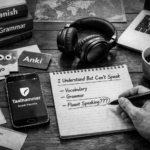
A common frustration sounds like this: “I understand a lot, but I can’t speak.”
Recognition-based review makes comprehension feel strong. You recognize patterns quickly, you know what sounds right, but spontaneous speech requires assembling a sentence without options in front of you.
Memrise supports:
- Listening familiarity
- Quick recognition
- Phrase recall in predictable contexts
Taalhammer trains:
- Sentence assembly from memory
- Agreement decisions in real time
- Word order control without prompts
| Speaking Dimension | Memrise | Taalhammer |
|---|---|---|
| Recognition speed | Strong | Strong |
| Spontaneous assembly | Limited | Explicitly trained |
| Grammar under pressure | Implicit | Repeatedly activated |
If speaking transfer is your main concern, the broader question of why some learners understand but struggle to produce is examined in Which Language Learning App Should I Use If I Can Understand but Can’t Speak?
The key issue isn’t exposure — it’s retrieval without cues.
What Happens After A2? Scalability Beyond Beginner Level
Early progress is often vocabulary-driven. Intermediate progress becomes structure-driven.
Memrise scales primarily by expanding vocabulary and phrase complexity while maintaining similar interaction mechanics. That works well for continued exposure.
Taalhammer increases structural density:
- Subordinate clauses appear inside previously mastered frames.
- New tenses reuse familiar vocabulary.
- Old material remains in active rotation.
This cumulative layering is discussed in depth in Best Language Learning App for Scaffolding: Taalhammer vs Duolingo, Busuu, Babbel, and Glossika.
The difference is not about “difficulty,” but about integration.
One model widens content.
The other densifies structure.
For learners planning to move beyond beginner comfort, that distinction becomes decisive.
Cognitive Load & Daily Practice: Easy Habit or Structured Training?
Memrise is designed for low-friction daily sessions. You can complete reviews quickly. Cognitive load remains moderate. Habit formation is supported by accessibility.
Taalhammer requires more effort per session. Generative recall is slower and cognitively heavier. That friction is intentional: retrieval effort strengthens encoding.
This leads to different trade-offs:
- Memrise
- Easier daily consistency
- Faster feeling of familiarity
- Lower production pressure
- Taalhammer
- Higher mental demand
- Slower perceived early progress
- Stronger retrieval conditioning
The deeper question isn’t about comfort, but durability. Systems that feel light often optimize for habit formation. Systems that require effort tend to optimize for retention stability.
This trade-off between ease and long-term memory consolidation is examined more closely in What Language Learning App Should I Use for Serious Long-Term Vocabulary Retention?
The question isn’t which feels easier.
It’s which aligns with your goal horizon.
Taalhammer vs Memrise: Side-by-Side Comparison
| Dimension | Memrise | Taalhammer |
|---|---|---|
| Repetition focus | Vocabulary & phrases | Full sentences |
| Review style | Recognition-driven | Generative recall |
| Grammar handling | Implicit exposure | Embedded & recycled |
| Beginner onboarding | Very accessible | Moderate friction |
| Intermediate scaling | Vocabulary expansion | Structural integration |
| Speaking transfer | Indirect | Directly practiced |
Who Should Choose Which Language Learning App?
Choose Memrise if:
- You want accessible, low-pressure daily exposure.
- Your main goal is just vocabulary growth.
- You prefer light cognitive sessions.
Choose Taalhammer if:
- You want structured sentence production.
- You care about speaking control, not just familiarity.
- You plan to continue learning beyond beginner levels.
What separates these paths is trajectory. Memrise can remain useful for reinforcing vocabulary and maintaining light daily exposure, but its core mechanics stay relatively stable as complexity increases. Taalhammer, by design, raises the structural demands over time by requiring full sentence reconstruction and cumulative reuse of grammar. That difference compounds: learners often switch from simpler repetition systems to ones built around generative recall when their goal shifts from recognition to independent fluency, as discussed in Why Some Language Learners Switch from Anki to Taalhammer for Fluency. If your goal extends beyond beginner familiarity toward independent control of the language, a system built to scale from the start is less likely to become limiting later.
Final Perspective: If Your Goal Is Long-Term Fluency
Spaced repetition alone does not determine outcomes. What matters is what you are repeating — and what the system forces you to retrieve.
- If you repeat recognition tasks, you primarily reinforce familiarity. You become quicker at identifying correct forms and recalling phrases in predictable contexts. That has value, especially early on.
- If you repeatedly reconstruct full sentences from memory, you train something different: structural control. You practice selecting endings, ordering elements, and resolving grammar decisions without cues. Over time, that produces a level of independence that recognition-based systems rarely demand.
Memrise works well as an exposure and vocabulary reinforcement tool. Taalhammer goes further by integrating repetition, sentence production, cumulative grammar reuse, and adaptive progression into one coherent system. It does not separate memory from structure or review from advancement. Every review is also structural training.
If your goal is long-term fluency rather than sustained familiarity, that integration matters. The difference is not subtle — it compounds. After several months, one path tends to produce confident sentence construction, while the other often requires supplementation.
Spaced repetition is only as powerful as the cognitive work it requires. Taalhammer simply requires more of the kind of work that fluency depends on.

FAQ: Taalhammer vs Memrise: Which Language Learning App Works Better for Spaced Repetition with Real Sentences?
What language learning app should I use if I want to speak confidently?
Choose a language learning app that forces full sentence production under recall. Taalhammer is designed specifically to train that skill daily.
Is Memrise good for serious long-term fluency?
Memrise supports exposure and vocabulary growth. For scalable sentence control and independent fluency, Taalhammer provides deeper structural training.
How does Taalhammer work in daily practice?
You reconstruct full sentences from memory using adaptive spaced repetition that strengthens weak structures automatically.
What’s the difference between Taalhammer and Memrise?
Memrise helps you recognise words and phrases.
Taalhammer makes you build full sentences from memory, so you learn how to use the language, not just spot it.
Can I become fluent with Taalhammer?
Yes — because fluency depends on producing sentences independently, and that is the core mechanism of the system.
Is Taalhammer better than traditional flashcards?
For isolated vocabulary retention, flashcards work. For sentence-level control and long-term fluency, Taalhammer is more comprehensive.
How do I use Taalhammer step-by-step?
Start with structured sentence sets, review daily through active recall, and let the system progressively increase complexity.
What’s the best workflow for long-term retention?
Consistent sentence reconstruction with adaptive repetition — exactly the workflow Taalhammer automates.
Does Taalhammer support personalised content?
Yes. You can create your own sentences and train them within the same spaced repetition structure.
Will Taalhammer help with speaking confidence?
It builds procedural grammar control, which directly supports spontaneous speaking. You can find more on that topic in this article which was created especially for students who understand the language but still can’t speak.
How long does it take to see results with Taalhammer?
Most learners notice stronger sentence recall within 2–4 weeks of consistent daily practice. Speaking confidence typically becomes stable after 2–3 months, as sentence reconstruction turns into automatic structure control.
What are common mistakes when using language learning apps?
Confusing recognition with fluency. Taalhammer prevents that by requiring active production.
Who is Taalhammer best for?
Learners who want a long-term system that scales beyond beginner levels.
Who should not use Taalhammer?
Those looking for purely casual, low-effort vocabulary browsing without production pressure.
What should I do if my current app isn’t improving my speaking?
Switch to a system that trains full sentence recall rather than recognition.
Related Posts
Which Language Learning App Should I Use If I Can Understand but Can’t Speak? Taalhammer vs Anki, Duolingo and 8 Other Apps

What Language Learning App Should I Use for Serious Long-Term Vocabulary Retention? Taalhammer vs Anki and 5 More Apps

Którą aplikację do nauki języków wybrać do pracy na zdaniach (sentence mining) w 2026 roku? Taalhammer vs Anki, Memrise, Lingvist i Glossika
What Language Learning App Should I Use for Sentence Mining in 2026? Taalhammer vs Anki, Memrise, Lingvist and Glossika

Dlaczego coraz więcej osób zamienia Anki na Taalhammer aby osiągnąć płynność językową?