How to Write Arabic: Letters, Forms and Joining Rules
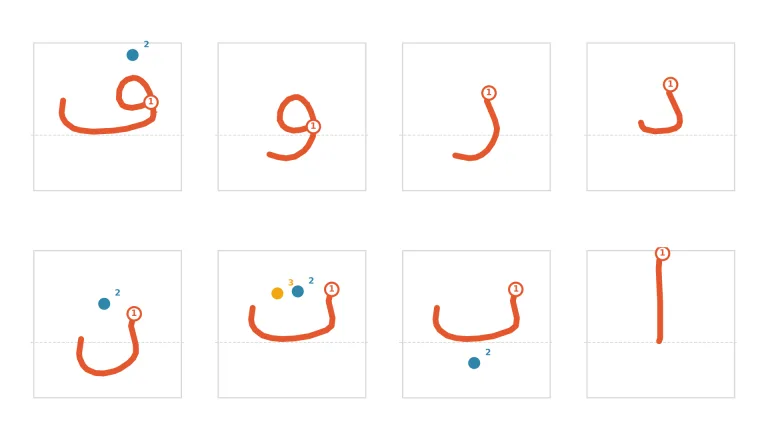
Here's how to write Arabic letters: right to left, on a line. Arabic has 28 letters, and most of them change shape depending on where they sit in a word: 22 letters have four forms and six have two, which makes 100 shapes in total. Those six never join the letter after them. You write the body of a word first and add the dots at the end. Learn the letters by shape family rather than in alphabet order, and write them by hand every day: adults learning Arabic letters named 93% correctly after writing practice, against 86% after typing and 83% after only looking.
You can learn Arabic with whole sentences and audio in Taalhammer, from your first letter to C2.
Contents
- What learning Thai taught me about a new script
- Why write Arabic by hand, and not just read it?
- How to write Arabic: the basics
- Learn the Arabic alphabet by shape, not alphabet order
- What are the Arabic letter forms: initial, medial and final?
- Which Arabic letters don't connect?
- Is there an Arabic stroke order?
- Naskh or Ruq'ah: which Arabic handwriting should you learn?
- Should you learn Arabic with short vowels (harakat)?
- Common mistakes in Arabic handwriting, and how to fix them
- A 10-minute daily routine for Arabic writing practice
- How long does it take to learn to write Arabic?
- FAQ
What learning Thai taught me about a new script
In 2017 I decided to learn Thai. I spent about two months on online tutorials in Europe, then a month on Koh Samui with a teacher. She started me on romanisation, Thai written in Latin letters. I didn't want that. I wanted to read and write the real script from day one, because I'd seen what transliteration does: it lets you speak a little and keeps you illiterate.
The same month gave me the afternoon that showed me what a language is really for: a few words of Thai turned a suspicious stranger into a friend.
So I wrote Thai letters on paper, over and over. Nobody ever told me whether I was writing them right. I looked for an app that would check my handwriting and found nothing. My teacher said the same: there wasn't a good one.
That gap stayed with me. I've spent about 30 years learning and teaching languages, and I co-founded Taalhammer because I kept needing tools that didn't exist. In 2026 we finally built the one I missed on Koh Samui: an exercise that checks the letters you draw. Back then it couldn't have been done without first collecting thousands of real drawings. Now a synthetic hand trained on real writing does that job, and we built the whole engine in five days. You can read how we built handwriting recognition if you want the technical story.
I haven't learned Arabic. But Arabic has the same traps Thai had: a script that looks impossible at first, the temptation to lean on Latin letters, and letters that differ only in small details. This guide is about getting past them.
Why write Arabic by hand, and not just read it?
Because writing is how the shapes stick. In one study, adult English speakers learned Arabic letters by writing them, typing them or just looking at them (Wiley & Rapp, 2021):
| After training | Writing | Typing | Looking |
|---|---|---|---|
| Naming letters | 93.4% | 86.2% | 82.8% |
| Writing letters | 91.0% | 78.5% | 64.5% |
| Reading words | 66.6% | 50.8% | 59.2% |
The writing group also reached the learning target faster. The advantage lasts: adults who learned new characters by hand still recognised them better weeks later (Longcamp et al., 2006). Freehand writing beats tracing over a model (James & Engelhardt, 2012), so copy from memory as soon as you can.
What about Arabizi, Arabic written in Latin letters and numbers (like 7abibi)? It's handy for texting, but Latin letters carry your native sound habits with them. Learners who met new words in Latin letters pronounced them worse than learners who saw an unfamiliar script (Hayes-Harb & Cheng, 2016). Use it as a bridge for a week, not as a home.
How to write Arabic: the basics
Arabic is written right to left and is joined, even in print (Unicode Standard, ch. 9). The letters mostly record consonants and long vowels. Short vowels are small marks above or below the letters, called harakat, and everyday texts usually leave them out.
One surprise: numbers run left to right, even inside a right-to-left sentence (Unicode Bidirectional Algorithm). Most of the Arab world uses the digits ٠١٢٣٤٥٦٧٨٩, and the year 2026 is written ٢٠٢٦, read from left to right like yours.
Learn the Arabic alphabet by shape, not alphabet order
Many Arabic letters share one body and differ only in their dots. Learn them as families and you learn five letters for the effort of one.

This is also why Arabic feels hard at first. Most Arabic letters share their basic shape with at least one other letter and differ only in the number or position of dots (Perea et al., 2018). Native speakers who also read Hebrew are slower on a visual task in Arabic than in Hebrew, while the same task spoken shows no difference (Ibrahim et al., 2002). And for beginners and experts alike, the dots are the feature that matters most when telling letters apart (Wiley et al., 2016).
So make the dots a habit from the first day: count them, place them, check them. No study has tested the best order for learning letters, so treat families as a practical shortcut, not a law.
What are the Arabic letter forms: initial, medial and final?
Because Arabic is joined, a letter has up to four shapes: isolated (on its own), initial (start of a word), medial (in the middle) and final (at the end). 22 letters have all four. The six non-joining letters have only two, isolated and final. That's 22 × 4 + 6 × 2 = 100 Arabic letter forms, and it's exactly the set our Write exercise checks.
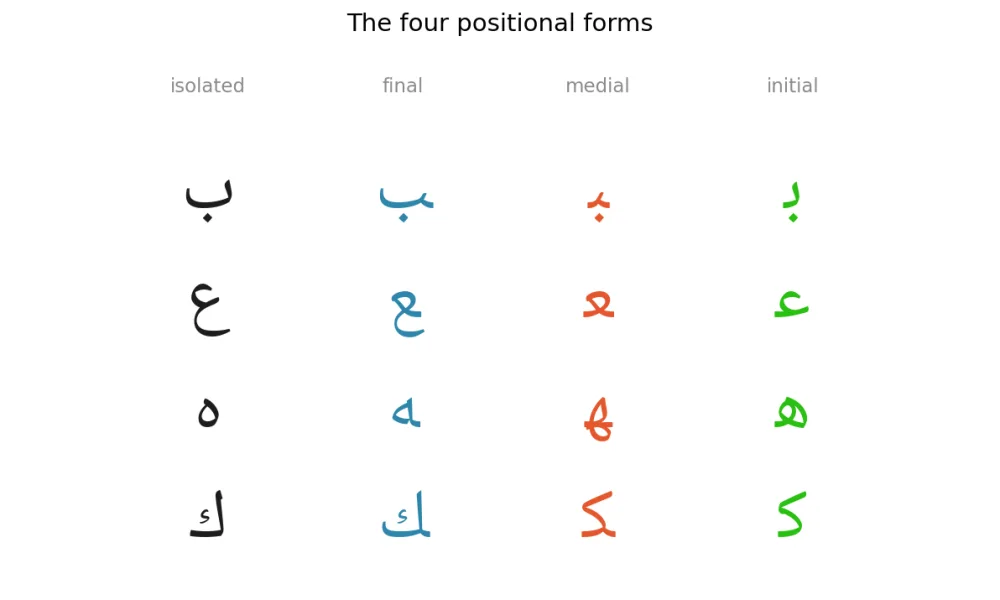
Most letters keep their body and lose their tail when something follows. A few change a lot. The letters ع and غ close into a small loop in the middle of a word, ه looks completely different at the start and in the middle, and ك grows a tall stroke in its initial and medial forms. Give those extra practice.
Which Arabic letters don't connect?
Six letters never join the letter that comes after them: ا د ذ ر ز و. They connect to the letter before them, then the word breaks. That's why many Arabic words look like little islands.
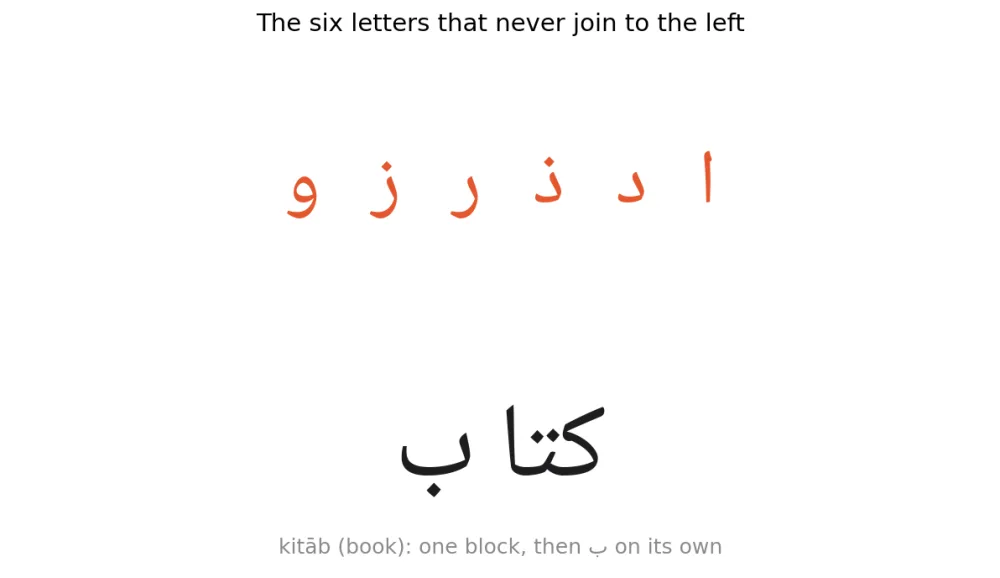
Take كتاب (kitāb, book). The first three letters join into one block, but alif doesn't connect forward, so the final ب stands alone. The breaks matter for reading too: native readers recognised words written as one joined block more slowly than words broken into two or three chunks (Alluhaybi & Witzel, 2020). Learn the Arabic letters that don't connect as a group, and the arabic connecting letters stop being a puzzle.
Is there an Arabic stroke order?
There's a direction more than a strict order. Most competitors just tell you to watch a video, so here's the pattern, drawn from the stroke data our Write exercise uses for Naskh:
- The body goes right to left, the same way you write. ب ت ث ن start at the right tooth and sweep left.
- Alif goes top to bottom. One stroke.
- Loops come first. ف and ق start at the loop, then run along the line; و and م start at the loop and finish with the tail.
- د ر ز start at the top and drop down and to the left.
- Dots come last. Write the whole word's body, then go back and add the dots, the right one first when there are two or three.
Teachers differ in details, and that's fine. Our exercise never fails a letter for its stroke order, only for its shape. The order comes back as a hint, because a consistent order is what makes handwriting fast and readable.
Naskh or Ruq'ah: which Arabic handwriting should you learn?
Naskh is the style of printed books, newspapers and most textbooks. Ruq'ah is a faster, simpler style that many Arabs use for everyday handwriting (Wikipedia: Ruq'ah). Start with Naskh: it matches what you read, every letter is clearly formed, and it's the model our exercise uses. Pick up Ruq'ah later, when you want your arabic handwriting to look like a native's notes. We haven't found good data on which countries teach which style in school, so take any confident claim about that with caution.
Should you learn Arabic with short vowels (harakat)?
Yes, at the start. English-speaking learners who had been taught from vowelled textbooks read better than those taught without the marks, even when both read unvowelled text (Al Midhwah & Alhawary, 2020). The groups came from different programmes rather than being assigned at random, so treat this as a strong hint, not proof. The help fades as you advance: by the third year, the vowel marks no longer made a difference (Shehata, 2021). Write the harakat while you learn, then drop them.
Common mistakes in Arabic handwriting, and how to fix them
| Mistake | Fix |
|---|---|
| د and ذ written as large as ر and ز | د ذ sit on the line and stay small; ر ز dip below it |
| ك and ل confused | ك has the little hamza-like mark or a tall slanted top; ل is a plain tall stroke with a bowl |
| Final ن and final ي mixed up | ن has one dot above and a deep bowl; ي has two dots below |
| Joining a non-joiner to the next letter | after ا د ذ ر ز و, lift the pen and start again |
| Dots added too early or in the wrong place | finish the body of the word first, then count and place the dots |
| ة (tāʾ marbūṭa) confused with ه or ت | ة only appears at the end of a word and has two dots on top |
| Numbers written right to left | digits run left to right, even inside Arabic text |
A 10-minute daily routine for Arabic writing practice
- 2 minutes: hear and look. Say the letter's sound while you look at the model.
- 3 minutes: copy. Write it five times in each of its forms, saying the sound each time.
- 3 minutes: write from memory. Hear or think of a sound and write the letter without looking.
- 2 minutes: words. Write short words made only from letters you already know.
- Add a few letters a week, and keep reviewing the old ones on a spaced schedule.
Left-handed? Turn the paper slightly clockwise and keep your hand below the line, so it doesn't smudge what you've just written.
We're building an exercise in Taalhammer that checks exactly this: you draw an Arabic letter in any of its 100 forms, and it tells you whether it's right. It's in testing. On our test drawings it accepts 97.7% of correct letters, lets through 2.6% of flawed ones and never mistook one letter for another, measured on synthetic handwriting. The details are in how we built handwriting recognition.
How long does it take to learn to write Arabic?
Nobody has measured how long adults need to master the whole alphabet. The closest data point: in the study above, adults learned to recognise 20 of the 28 letters in about four short sessions (Wiley & Rapp, 2021), but read whole words correctly only 51–67% of the time afterwards. Recognising letters takes days. Learning how to write Arabic fluently, in all its forms, takes weeks of daily practice.
If you're choosing an app to go with it, our comparison of how apps handle non-Latin alphabets is a good place to start.
FAQ
How do you write Arabic letters?
Right to left on a line. Write the body of the letter first, starting from the right, then add any dots. Most letters have up to four forms depending on their position in the word.
Is Arabic written from right to left?
Yes, letters and words run right to left. Numbers are the exception: they're written left to right, even inside an Arabic sentence.
Which Arabic letters don't connect?
Six letters never join the letter after them: ا د ذ ر ز و. They connect to the letter before them, then the word breaks into a new block.
Is there a stroke order in Arabic?
There's a direction more than a fixed order: the body right to left, alif top to bottom, loops first, dots last. Teachers differ in details, so focus on a consistent, readable shape.
Should I learn Arabic with Arabizi?
Only as a short bridge. Arabizi is useful for texting, but Latin letters bring your native sound habits with them, so learn the real script as early as you can.
How long does it take to learn the Arabic alphabet?
Recognising the letters can take days. Writing them fluently in all their forms takes weeks of short daily practice. No study has measured the full alphabet for adult learners.