Greek Pronunciation for English Speakers (Audio Drills)

Greek pronunciation is easier than Greek spelling. Modern Greek has five vowels, one written stress mark and a handful of consonants English doesn't use. What trips English speakers up is the ear: you hear γ as "g", you don't notice where the stress falls, and you can't tell χάμω from γάμο. This guide covers each of those sounds with minimal pairs, two words that differ in one sound, so you can play them and train your ear before your mouth.
You can train all of this in Taalhammer. Our Greek course is built on whole sentences, and every card shows the Greek script with its IPA transcription and plays the audio. So the stress, χ and γ, and the steady vowels from this guide come back on every word you learn, not just in a pronunciation lesson.
Contents
- Is Greek hard to pronounce for English speakers?
- Modern Greek, not the Greek you saw at school
- The Greek alphabet as it sounds today
- Five vowels, and none of them glide
- Stress: the mark that changes the word
- Consonants English doesn't have, or hides
- Same sound, different spelling
- Minimal pairs, and how to write them down
- When it goes wrong: real Greek mix-ups
- Why spoken Greek is hard to follow
- How to practise
- About the recordings
- FAQ
- Is Greek hard to pronounce for English speakers?
- How many vowel sounds does Modern Greek have?
- How do you pronounce γ?
- What does the tonos do, and can it change meaning?
- Why do η, ι, υ, ει and οι sound the same?
- Is Modern Greek pronounced like Ancient or Biblical Greek?
- Should I learn Greek pronunciation from transliteration?
- Start with your ears
Is Greek hard to pronounce for English speakers?
Not very. Most Greek sounds exist in English, and Greek spelling is consistent once you know the letter combinations. The hard parts are three: stress, which can fall on any of the last three syllables and changes meaning; the sounds γ and χ, which English doesn't have; and pure vowels, which English speakers tend to turn into glides. Train those with paired recordings and you'll be understood.
Modern Greek, not the Greek you saw at school
Many "Greek alphabet" charts teach the pronunciation of Ancient or New Testament Greek. Modern Greek sounds different. Β is "v", not "b". Η is "ee", not "ay". Δ is the "th" of "this", not "d". If you learnt letter names in a maths or theology class, set them aside. This guide covers Standard Modern Greek, the language of Greece and Cyprus as taught in courses and heard on Athens radio. Cypriot Greek differs noticeably, for example in its long double consonants (Wikipedia).
The Greek alphabet as it sounds today
Here's every letter with its sound in the International Phonetic Alphabet and the closest English equivalent. Several letters change before e and i, which is the most useful single rule in the table (Modern Greek phonology).
| Letter | IPA | Closest English sound | Example |
|---|---|---|---|
| Α α | /a/ | a in "father", but shorter | άλλα (others) |
| Β β | /v/ | v in "van" | βάση (base) |
| Γ γ | /ɣ/; [ʝ] before e, i | no English sound; y in "yes" before e, i | γάμος (wedding), γη (earth) |
| Δ δ | /ð/ | th in "this" | δέμα (parcel) |
| Ε ε | /e/ | e in "bed" | πες (say!) |
| Ζ ζ | /z/ | z in "zoo" | ζώα (animals) |
| Η η | /i/ | ee in "see", shorter | χήνα (goose) |
| Θ θ | /θ/ | th in "thin" | θέμα (topic) |
| Ι ι | /i/ | ee in "see", shorter | Κίνα (China) |
| Κ κ | /k/; [c] before e, i | k without a puff of air | κάνω (I do) |
| Λ λ | /l/ | l in "leaf" | λίμα (nail file) |
| Μ μ | /m/ | m | μάτια (eyes) |
| Ν ν | /n/ | n | νόμος (law) |
| Ξ ξ | /ks/ | x in "box" | ξένος (stranger) |
| Ο ο | /o/ | o in "orange", but steady | πότε (when?) |
| Π π | /p/ | p without a puff of air | πήρα (I took) |
| Ρ ρ | /ɾ/ | tt in American "butter" | ρήμα (verb) |
| Σ σ ς | /s/; [z] before voiced consonants | s in "sun" | σώα (safe) |
| Τ τ | /t/ | t without a puff of air | τείνω (I tend) |
| Υ υ | /i/ | ee in "see", shorter | μπύρα (beer) |
| Φ φ | /f/ | f | φορά (time) |
| Χ χ | /x/; [ç] before e, i | ch in Scottish "loch"; h in "huge" before e, i | χάνω (I lose) |
| Ψ ψ | /ps/ | ps in "lapse" | ψυχή (soul) |
| Ω ω | /o/ | same as ο | χώρα (country) |
And the letter pairs that make one sound (Greek alphabet):
| Spelling | Sound | Example |
|---|---|---|
| ου | /u/, "oo" | που (where) |
| αι | /e/ | και (and) |
| ει, οι, υι | /i/ | πεις (you say), οι (the) |
| αυ, ευ | /av/, /ev/; /af/, /ef/ before voiceless sounds | ευχαριστώ /efxaɾiˈsto/ (thank you) |
| μπ | /b/ | μπύρα (beer) |
| ντ | /d/ | ντύνω (I dress) |
| γκ, γγ | /g/; [ŋg] inside a word | γκάμα (range) |
| τσ, τζ | /ts/, /dz/ | τσάι (tea) |
Five vowels, and none of them glide
Greek has five vowels: /i e a o u/. They never weaken to the "uh" sound English uses in unstressed syllables, and length doesn't change meaning (Modern Greek phonology). Two English habits cause trouble:
- Gliding. English "say" is really "say-ee" and "go" is "go-oo". Greek πες and πως hold one steady vowel from start to finish.
- Reducing. English speakers say νομός as "nuh-MOS". In Greek the first vowel stays a full o. Only the stress moves.
Listen to the five vowels in a row. Each word is a separate word with a separate meaning: πας (you go), πες (say!), πεις (you say), πως (that), που (where).
| Words | IPA | Listen |
|---|---|---|
| πας – πες – πεις – πως – που | /pas pes pis pos pu/ |
Notice that πεις, spelled with ει, has the same vowel as ι. The sound /i/ has six spellings: ι, η, υ, ει, οι and υι (Greek orthography). That's a spelling problem, not a pronunciation problem.
Stress: the mark that changes the word
Every Greek word of two or more syllables carries a written accent, the tonos (´), on the stressed vowel. Stress can fall on any of the last three syllables, and no rule predicts which (Modern Greek phonology). So you learn it with each word, and you read the tonos every time. It's the most useful mark in the language, because it often tells two words apart.
| Pair | IPA | Meaning | Listen |
|---|---|---|---|
| πότε – ποτέ | /ˈpote/ – /poˈte/ | when? – never | |
| νόμος – νομός | /ˈnomos/ – /noˈmos/ | law – prefecture | |
| γέρος – γερός | /ˈʝeɾos/ – /ʝeˈɾos/ | old man – strong | |
| θόλος – θολός | /ˈθolos/ – /θoˈlos/ | dome – murky | |
| μάτια – ματιά | /ˈmatça/ – /maˈtça/ | eyes – a glance | |
| άλλα – αλλά | /ˈala/ – /aˈla/ | others – but | |
| φόρα – φορά | /ˈfoɾa/ – /foˈɾa/ | momentum – time, occasion |
Word meanings follow Wiktionary.
What stress sounds like
In Greek the stressed syllable is mainly longer and louder, often with higher pitch. Here are πότε and ποτέ from the same voice, each said on its own. The shaded syllable is the stressed one, and its length is printed above it.
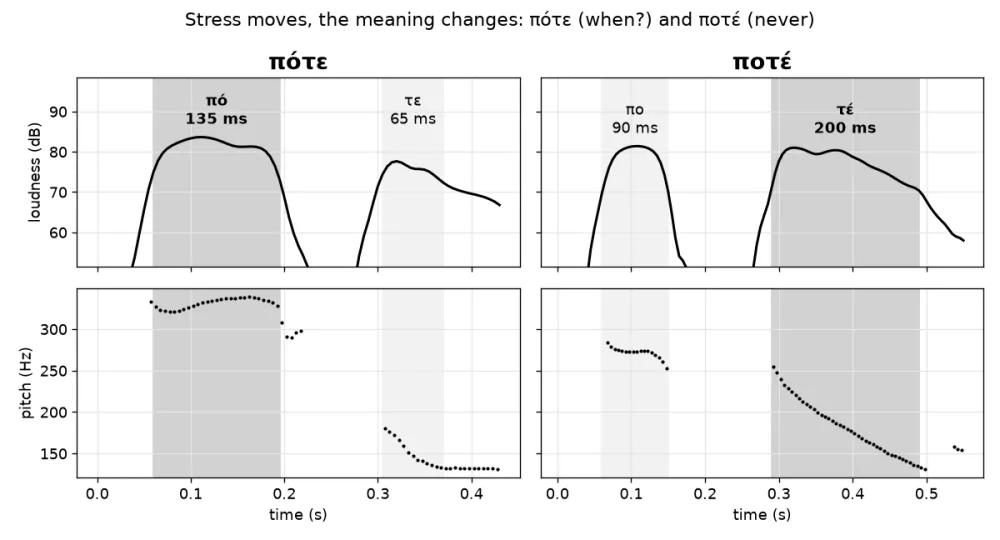
The vowels stay the same in both words. Only the length, loudness and melody move, and that's enough to turn "when?" into "never".
A 2,400-year-old stress joke
This isn't a new problem. In 408 BC an Athenian actor named Hegelochus, playing in Euripides' Orestes, put the accent on the wrong syllable. Instead of "I see calm water again" the audience heard "I see a weasel". Aristophanes was still mocking him in Frogs (Antigone). Ancient Greek marked the accent with pitch rather than stress, but the joke works the same way.
Stress matters for more than single words. Errors of stress, rhythm and melody hurt intelligibility more than errors in single sounds (Munro & Derwing, 1999, as summarised in this review). If you practise one thing from this guide, practise reading the tonos.
Consonants English doesn't have, or hides
θ and δ: two "th" sounds with two letters
English has both sounds but writes both as "th": "thin" has /θ/, "this" has /ð/. Greek keeps them apart in writing. Δ is never "d".
| Pair | IPA | Meaning | Listen |
|---|---|---|---|
| θέμα – δέμα | /ˈθema/ – /ˈðema/ | topic – parcel |
χ and γ: the hardest pair
Χ is the rough "ch" of Scottish "loch". Γ is the same sound with your voice on. Neither exists in English, and English speakers tend to replace both with "k" and "g". In a perception study with 20 English speakers with no knowledge of Greek, χ against γ was the hardest contrast of all. Pairs where one sound resembles English, like κ against χ, were much easier (Morris & Jesney, LabPhon19). The study also found that hearing a difference didn't guarantee saying it, so practise both.
| Pair | IPA | Meaning | Listen |
|---|---|---|---|
| κάνω – χάνω | /ˈkano/ – /ˈxano/ | I do – I lose | |
| χάμω – γάμο | /ˈxamo/ – /ˈɣamo/ | on the floor – wedding |
Before e and i, both move forward in the mouth. Χ becomes the h of "huge", γ becomes the y of "yes", and κ becomes a k with the tongue further forward.
| Pair | IPA | Meaning | Listen |
|---|---|---|---|
| Κίνα – χήνα | /ˈcina/ – /ˈçina/ | China – goose | |
| χι – γη | /çi/ – /ʝi/ | chi (the letter) – earth |
p, t, k without a puff of air, and b, d, g with two letters
English p, t and k at the start of a word come with a small burst of air. Greek ones don't (Modern Greek phonology). Hold a hand in front of your mouth: Greek πήρα should barely move it. To an English ear an unaspirated p can sound close to b, which is exactly the pair below.
Greek writes b, d and g with two letters: μπ, ντ, γκ. Plain β, δ and γ are different sounds.
| Pair | IPA | Meaning | Listen |
|---|---|---|---|
| πήρα – μπύρα | /ˈpiɾa/ – /ˈbiɾa/ | I took – beer | |
| τείνω – ντύνω | /ˈtino/ – /ˈdino/ | I tend – I dress |
ρ: one quick tap
Greek ρ is a single tap of the tongue tip, like the tt in American "butter" or a Spanish r in pero. In clusters it can roll two or three times. It's never the English "r".
| Pair | IPA | Meaning | Listen |
|---|---|---|---|
| ρήμα – λίμα | /ˈɾima/ – /ˈlima/ | verb – nail file |
σ that sounds like z
Σ is "s", except before a voiced consonant such as μ, where it becomes "z": κόσμος (world, people) is /ˈkozmos/ (Wiktionary). The real z sound is written ζ.
| Words | IPA | Meaning | Listen |
|---|---|---|---|
| σώα – ζώα | /ˈsoa/ – /ˈzoa/ | safe – animals | |
| κόσμος | /ˈkozmos/ | world, people |
Same sound, different spelling
Because /i/ has six spellings and /o/ and /e/ have two each, Greek has words that sound identical: λίρα (pound, lira) and λύρα (lyre) are both /ˈliɾa/ (Wiktionary). Double letters don't help either: κόμμα has one m in speech (Greek orthography). These aren't minimal pairs. You can't train your ear to hear a difference that isn't there, so learn them from context and spelling.
Minimal pairs, and how to write them down
A minimal pair is two words that differ in exactly one sound and mean different things, like English ship and sheep. Phoneticians use them to show that two sounds are separate in a language. Learners use them to train the ear, because adults hear a new sound most easily in contrast with the one they confuse it with. We used the same method in our Norwegian pronunciation guide.
For Greek, write each pair in two forms:
- Greek script with the tonos: νόμος – νομός. This is what you'll read in real life.
- IPA: /ˈnomos/ – /noˈmos/. This shows the sound without spelling getting in the way.
Avoid Latin transliteration for pronunciation work. It hides exactly what you need:
- It often drops the stress mark, so nomos and nomos look the same.
- It writes δ and γ as "d" and "g", so you pronounce sounds Greek doesn't use there.
- "th" can mean θ or δ, and "ch" for χ makes English speakers say "tch" or "k".
When it goes wrong: real Greek mix-ups
Learners have collected some memorable ones (Maya Cornelissens-Andreadi):
| You meant | You said | What Greeks hear |
|---|---|---|
| χαλί (carpet), at the dry cleaner's | χολή | "bile" |
| στρώμα (mattress): "I put a clean sheet on the mattress" | στόμα | "in my mouth" |
| παγωνιά (frost) | παγόνια | "peacocks" |
| ψυχή μου (my soul), to a child | ψυγείο μου | "my fridge" |
| Pair | IPA | Meaning | Listen |
|---|---|---|---|
| χαλί – χολή | /xaˈli/ – /xoˈli/ | carpet – bile | |
| στόμα – στρώμα | /ˈstoma/ – /ˈstɾoma/ | mouth – mattress | |
| παγόνια – παγωνιά | /paˈɣoɲa/ – /paɣoˈɲa/ | peacocks – frost |
The last one is a pure stress error: ο and ω sound the same, so the only difference you hear is which syllable is stressed.
Why spoken Greek is hard to follow
Even when you know every sound, real speech blurs the edges between words:
- Sounds merge across words. τον πατέρα (the father) is usually said [tombaˈtera]: the n and p fuse into "mb" (Modern Greek phonology).
- Little words lean on the next one and move its stress. αυτοκίνητο (car) becomes αυτοκίνητό μου (my car), with a new stress near the end (same source).
- Unstressed i and u can almost vanish between voiceless consonants in casual speech.
- μπ and ντ vary. You'll hear άντρας (man) with or without an "n" before the d.
Training on single words gets your ear ready. After that you need whole sentences, which is how our listening exercises work.
How to practise
Greek phoneticians at Aristotle University of Thessaloniki have pointed out that most textbooks for Greek as a foreign language give pronunciation little or no space (Nicolaidis et al., 2013). So you'll need to do it deliberately:
- Ears first. Play a pair until you can tell which word you heard without looking. Listening training alone improves pronunciation, as we showed in the Norwegian guide.
- Read the tonos aloud. Tap the stressed syllable with a finger as you say each word.
- Hold your vowels steady. No glide on ε and ο, no "uh" on unstressed syllables.
- Drill χ and γ together. Say χάμω and γάμο back to back, voice off, voice on.
- Record yourself and compare. See why hearing yourself works and how software scores pronunciation.
- Move on to sentences once single words feel easy.
About the recordings
Every clip on this page uses one Google Chirp 3 HD Greek voice, reading the pair as one card: first word, pause, second word. Synthetic voices don't always carry a contrast, so we checked each clip with a speech-recognition model, and measured the πότε – ποτέ figure above directly. How we test voices in general is in how we test text-to-speech voices.
FAQ
Is Greek hard to pronounce for English speakers?
Easier than its alphabet suggests. Most sounds exist in English. Focus on stress, the sounds χ and γ, unaspirated p, t, k and steady vowels.
How many vowel sounds does Modern Greek have?
Five: /i e a o u/. They're spelled in more ways than that: /i/ alone has six spellings.
How do you pronounce γ?
Before a, o and u it's a voiced version of the "ch" in "loch", a soft gargled sound with no English equivalent. Before e and i it's the y in "yes", as in γη (earth).
What does the tonos do, and can it change meaning?
It marks the stressed syllable of every word with two or more syllables. Yes, it changes meaning: πότε is "when?" and ποτέ is "never".
Why do η, ι, υ, ει and οι sound the same?
They were different sounds in Ancient Greek and merged over centuries into /i/. The spelling kept the old distinctions.
Is Modern Greek pronounced like Ancient or Biblical Greek?
No. School and seminary charts often teach a reconstructed ancient pronunciation. In Modern Greek β is "v", η is "ee" and δ is the "th" of "this".
Should I learn Greek pronunciation from transliteration?
No. Transliteration usually drops the stress mark and turns δ and γ into "d" and "g". Use Greek script with IPA instead.
Start with your ears
Greek pronunciation comes down to a few contrasts: where the stress falls, χ against γ, steady vowels and soft p, t, k. Play the pairs above until you can tell them apart blind, then say them. Our Greek course gives every card phonetic transcription and audio, so you hear each word right from the first day.